I saw someone skating an amazingly graceful move at the Bryant Park ice rink last Christmas. Until then I wasn’t really interested in ice skating – figure skating wasn’t for me, and hockey looked too violent. But this amazing freestyle move shocked me, and made me buy a pair of ice hockey skates, to started to learn it.
First, I had to find out what this move was called, before I could learn it. And finding it online proved to be nontrivial. First, there was scarcely anything written about it online for one to find using words. Also, nobody bothered to piece together still frames into a stop motion sequence of images, until I did, so Google image search didn’t work very well either. Finally, after sifting through endless ice skating videos on YouTube, I found it. It is called the Grapevine move. And this Grapevine tutorial video shows it in its full glory at the end.

Stop motion picture of Jordan skating the Grapevine stitched from the Hockey Tutorial video
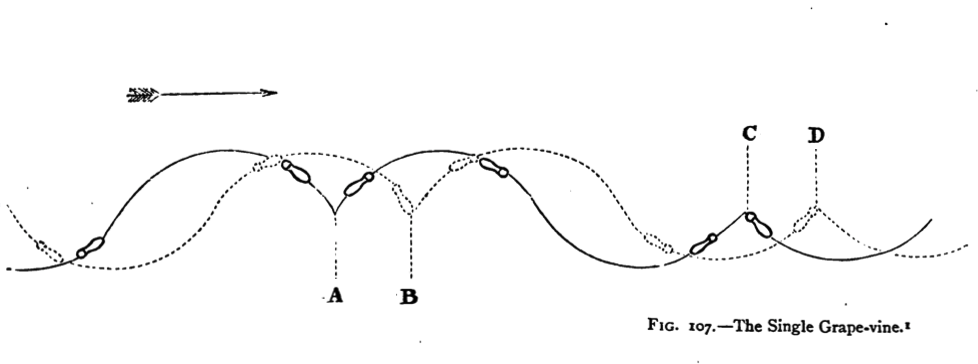
Grapevine is a classic skating move skated exclusively on outside edges, which when done to perfection appears to an onlooker as if the skater had Jackson’s moonwalk power, and could magically propel herself indefinitely in a straight line while constantly turning forward and backward, and with both skates on the ground at all times without showing signs of any efforts to push herself onward.
So I took to the rink and tried to practice the Grapevine based on the tutorial video mentioned above. It turned out that one didn’t simply jump from barely skating forward without falling, to being able to execute the Grapevine. Many other skills of intermediate difficulty had to be learned and practiced, before one could skate a recognizable Grapevine. That great video tutorial gave me a false sense of achievability by breaking the move into seemingly effortless segments. What the author didn’t tell you was that he assumed that the learner was already an accomplished figure skater or hockey player, and just wanted to dabble in some freestyle fun. He took it for granted that no toddler would try to run the 100-meter dash at the Olympics.
I tripped, and I fell as I tried to Grapevine. While brooding over my failure on the bench, I watched others skate. Then I started to imitate how they skated, and I watched hockey tutorials online. Every time I learned a new basic skill, I found I could do a part of the Grapevine slightly better. Eventually I understood what skating was all about: the edge, leaning into the edge, the posture, the balance, and most importantly the use of posture to transfer balance from one foot to the other.
Here is my account of how I (almost) learned to skate a two-foot move such as the Grapevine. I am going to describe the learning process in a new language of moment of balance, falling and recovery, unlike how most tutorials explain the move. Perhaps I can provide fresh ideas on learning this move, on two-foot skating and on skating in general, from the perspective of a newbie. I have watched and re-watched countless number of tutorial videos, and have bought and read great books on ice skating written at the turn of the last century. And in analyzing skating and the Grapevine move for this article, I found that I now understand what I was doing wrong, and perhaps can finally learn to Grapevine gracefully.
Update 2021-09-20: I wrote a follow-up article to this one, for inline skaters: Learn the Two-foot Grapevine on Inline Skates.
Continue reading →

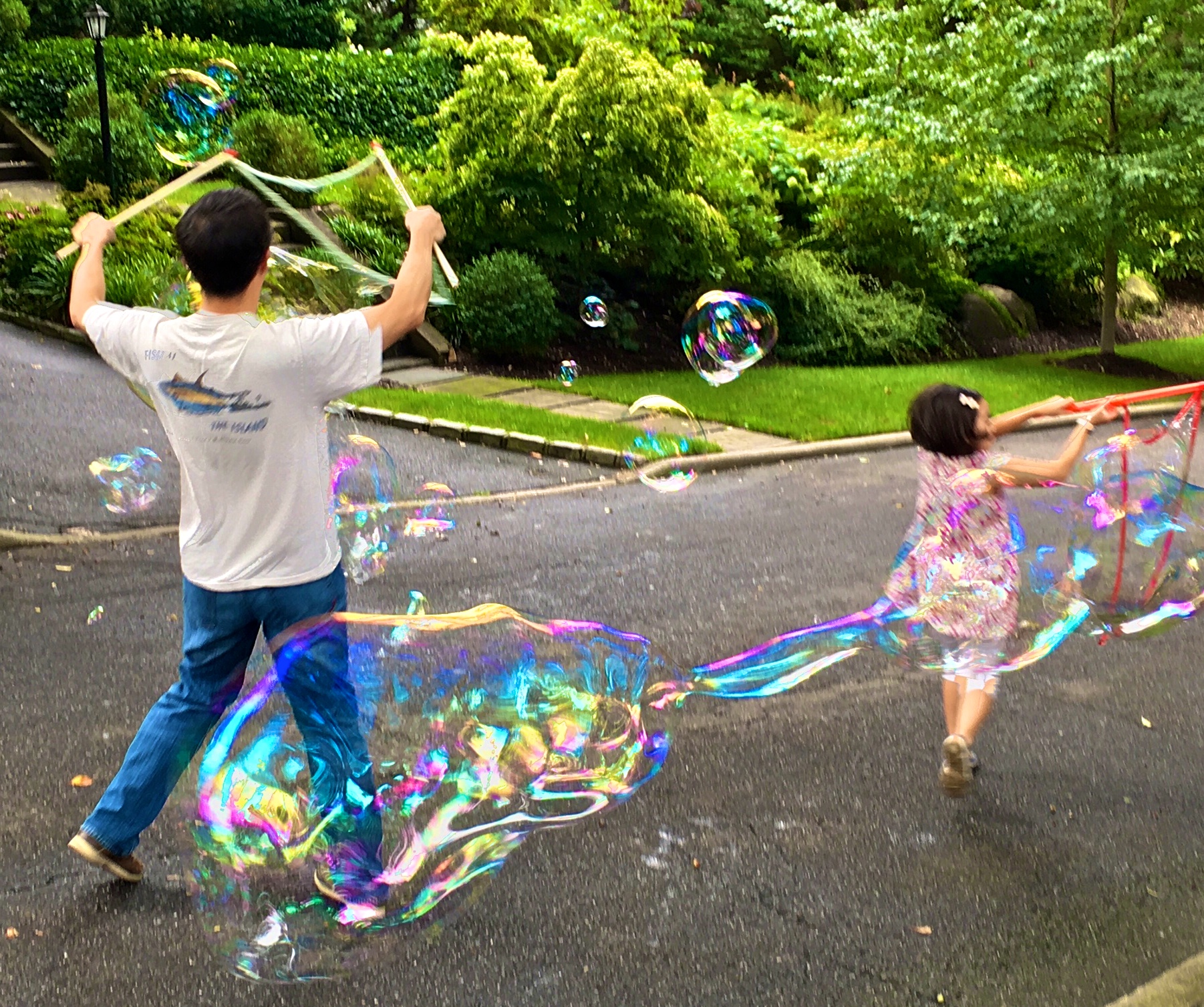 Following is a video of gigantic bubbles in slow motion, at the Sands Point Preserve.
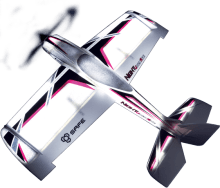 These SAFE® features annoy veteran flyers to no end, and render most of these fine aircraft useless to experienced flyers, unless the $80 AS3X receiver is replaced with a normal receiver. Take the
  But it turns out that most of these planes actually come with an extremely capable $80 Spektrum AR636A Sport receiver, and it can be reprogrammed using just a smartphone and a special programming cable. You can change gyro rate gains, as well as heading gains. You can completely turn off AS3X stabilization in any of the three receiver-side flight modes, if you want to fly your plane without gyro stabilization.



 Xinhai Dude