
-
Recent Posts
- Kuhio Beach and Ponds in November
- Life around Manhasset Bay
- Hanauma Bay for the chronically overprepared
- Kayak to Kaneohe Sandbar – sunken at high tide
- Why does my snorkel mask fog up?
- Waikiki & Honolulu landmarks seen from departing flight DL650
- Actual landing flight path of Delta 650 at JFK runway 22L
- Reign Ares as big-wheel skates for urban marathons
- What are carbon-fiber inline skates ?
- Big Wheels on Carbon Hockey Skates
- Where to Inline Skate on Long Island
- Check that your sunglasses block out all UV rays
Top Posts
- How to Inline Skate
- What Exactly is a Peeled Extreme Beef Tenderloin from Costco?
- Battlefield 1 Soldier Uniforms from all Factions
- What happens when you let saturated salt water dry up completely?
- Hanauma Bay for the chronically overprepared
- Asian-fit helmets are a lot of hot air
- Allemande from Bach Cello Suite 1 (BWV 1007)
- Reign Ares as big-wheel skates for urban marathons
Categories
- Classical Music (16)
- Cello (11)
- Composition (6)
- Free Sheet Music (16)
- Fun (83)
- Being a Wikipedian (44)
- Drawings and Paintings (7)
- Gourmet (3)
- Hawaii (6)
- Ice Skating (4)
- Inline Skating (23)
- Photography (30)
- Travel (29)
- Planes (32)
- Flight Simulations (7)
- HHAMS (18)
- RC Planes (12)
- Real Planes (3)
- Science (11)
- Atheism (3)
- Debuking Pseudoscience (2)
- Evolution (6)
- Short Stories (3)
- 中文 (14)
- Classical Music (16)
Archives
- January 2026 (1)
- December 2025 (4)
- November 2025 (2)
- November 2024 (1)
- October 2024 (2)
- August 2024 (1)
- June 2024 (1)
- March 2024 (1)
- January 2024 (1)
- August 2022 (3)
- July 2022 (2)
- June 2022 (1)
- May 2022 (1)
- April 2022 (2)
- March 2022 (2)
- November 2021 (1)
- October 2021 (9)
- September 2021 (1)
- October 2020 (1)
- August 2020 (1)
- June 2019 (4)
- April 2019 (1)
- March 2019 (1)
- January 2019 (1)
- December 2018 (5)
- November 2018 (1)
- May 2018 (1)
- April 2018 (1)
- January 2018 (1)
- December 2017 (5)
- November 2017 (2)
- October 2017 (3)
- June 2017 (3)
- April 2017 (6)
- March 2017 (2)
- February 2017 (9)
- December 2016 (10)
- November 2016 (3)
- September 2016 (1)
- August 2016 (2)
- July 2016 (1)
- May 2016 (4)
- April 2016 (3)
- March 2016 (2)
- December 2015 (1)
- October 2015 (1)
- September 2015 (1)
- August 2015 (1)
- December 2014 (1)
- July 2013 (4)
- June 2013 (6)
- May 2012 (1)
- March 2012 (1)
- February 2012 (2)
Meta
-
-
Tag Archives: Inline Skating
Reign Ares as big-wheel skates for urban marathons

As a postscript to Big Wheels on Carbon Hockey Skates, I mentioned that I discovered Powerslide Reign Ares 100. They look like carbon hockey skates. Yet they’re equipped with Trinity mounts for big wheel configurations, such as 3x110mm. These skates seemingly disproved my assertion that “you simply can’t buy skates with big wheels on full-bodied, carbon hockey shells – they don’t exist”.
I bought a pair of Reign Ares, heat-molded them, and skated on them. I’ve examined them, and pondered on the internal structure of these skates for a week now. I’ve done all I could, to divine how they are made, short of cutting my new skates up. I can confidently say that, “they are no carbon hockey skates”.
But I love them. I think they are the best answer to my quest to find big wheels on carbon (almost) hockey skates. This long post documents my journey to customize and set up Reign Ares. I turned them into the right big-wheel skates for me, for urban marathons such as Wednesday Night Skate NYC.
Continue reading
Big Wheels on Carbon Hockey Skates
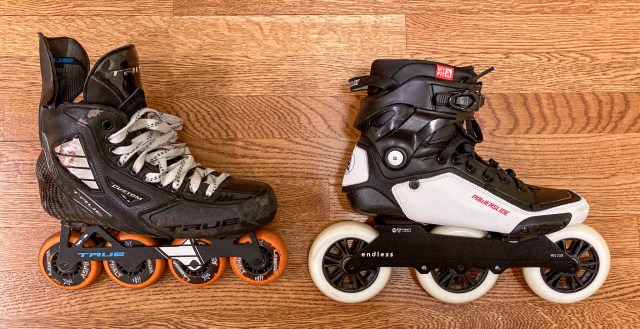
I’ve been skating for a while on inline hockey skates with four 80mm wheels. These are normal-sized wheels popular since decades ago. These skates are great for urban skating on paved streets, skating on bike trails, skating at an outdoor rink, slalom skating around cones, and doing two-foot wizard skating moves.
But they are no good for marathon skating like folks do at Wednesday Night Skate NYC. So I set out to get myself a setup with three 110mm wheels. But it turned out that nobody makes carbon-fiber hockey skates that can take wheels bigger than the usual 80mm. So I had to compromise and make modifications to commercially-available skates, in order to mount big wheels on them.
Where to Inline Skate on Long Island

The availability of skateable trails on Long Island is pitiful, compare to that in New York City. Despite having a much larger landmass, Long Island features very few publicly-accessible trails with paved and clean surfaces. To wit, click on the follow image to look at biking trails and bike-friendly roads in Nassau county compared to NYC, Queens and Brooklyn.
But not all biking trails and bike-friendly roads are suitable for inline skating. Some trails go significantly uphill and downhill – a challenge for beginner skaters. Some trails are not regularly maintained, and are full of debris that can trip an oblivious rollerblader. Furthermore, sharing a road with actual traffic is not something an inline skater would normally do.
For street hockey rinks and skateparks near Nassau, including some locations from Queens, head to the article on Public Skateparks on Long Island.
Outside of these parks, there are actually a few nice biking trails near Nassau that are relatively usable for inline skaters. You can find these trails on the Long Island Bikeways & Trailways map, published by the department of transportation.
Continue reading
Posted in Fun, Inline Skating
Tagged Inline Skating, Public Skateparks on Long Island
Leave a comment
How to skate Mabrouk: 4 slalom components

This is part 2 of a series on Mabrouk. In this part I describe in excruciating details the four slalom components of Mabrouk previously summarized in What is Mabrouk: a slalom variant of Grapevine. I learned to skate a sustained Mabrouk by first practicing the four slalom components, and by connecting them with rudimentary transitions. I later refined these transitions to make the entire Mabrouk sequence flow, but that is for part 3 and beyond of this series.
Posted in Inline Skating
Tagged grapevine, How-to, Ice Skating, inline skates, Inline Skating, Mabrouk, Slalom, tutorial, two-foot skating tricks
2 Comments
What is Mabrouk: a slalom variant of Grapevine

Mabrouk is a slalom variant of the figure skating move called Grapevine. The Grapevine skating pattern is described and diagramed as early as 1880 by Vandervell and Cox in “A System of Figure-skating”. The slalom version is presumably named after Swiss slalomer Eddy Mabrouk. Both Mabrouk and Grapevine employ the same exact 4 components, namely forward/backward criss-cross, and forward/reverse eagle.
While Mabrouk emphasizes curved patterns traced around equal-spaced cones forming a straight line, Grapevine strives to have the skater move in a streamline without giving explicit thoughts to slalom components. The difference can be seen in patterns they trace on the ground as presented below. Continue reading
Posted in Inline Skating
Tagged grapevine, How-to, Ice Skating, inline skates, Inline Skating, Mabrouk, Slalom, tutorial, two-foot skating tricks
Leave a comment
Asian-fit helmets are a lot of hot air

Asian Americans who bike or skate know that helmets sold in America are generally not shaped properly for Asian heads. This is a phenomenon alien to most non-Asian people. Lately some brands have come out with so-called “Asian Fit” models. After an extensive research, I think these are just hot air, except for possibly a few exceptions. Continue reading
Wednesday Night Skate NYC
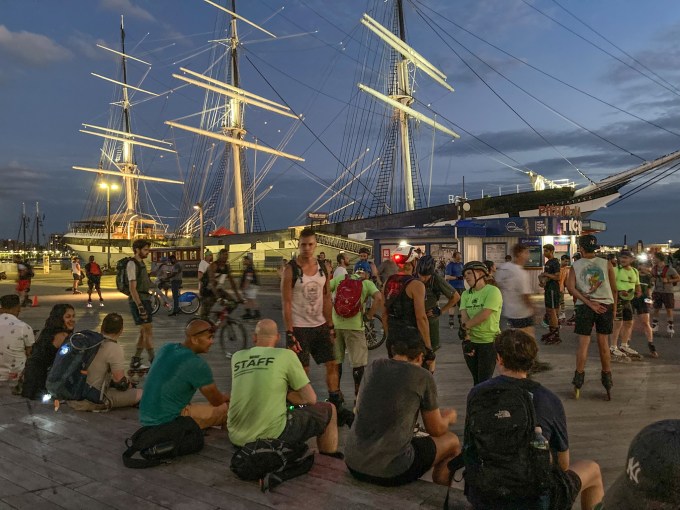
Wednesday Night Skate NYC is also known as WNS NYC. It’s one of several well-established groups in the city. Some say it’s the biggest group of them all. WNS is run by volunteers since the late 1990s. Every Wednesday from April to October, weather permitting, organizers show up wearing yellow-green vests at the south-side steps of Union Square around 7:45pm. By then a sizable crowd of skaters have already gathered at the steps. At 8pm an organizer gives a brief safety speech and introduces the route planner of the week, as even more skaters materialize all of a sudden at the steps. One organizer is appointed the leader of the day, and another the sweeper of the day. Folks are told not to skate ahead of the leader. The sweeper makes sure to leave no skater behind. Shortly after, skaters launch like a swarm of giant locusts, to descend upon the streets of New York City at dusk. The leader signals followers to take breaks at pre-designated stops along the route, so that the rest of the group may catch up, with the sweeper being the last person to arrive at each stop. The route circles back to Union Square, where a day’s skating concludes. Continue reading
Slalom bladers at Corona Park

Slalom bladers practice at a well-paved area behind Mist Garden at Flushing Meadows Corona Park in Queens. The surface of Mist Garden is quite smooth for inline skating as well, when it’s not spewing fog and mist. You will find Mist Garden right next to the Unisphere which skateboarders and bladers alike have also turned into a skating rink. Continue reading
Posted in Inline Skating
Tagged Inline Skating, Inline Skating Rink, Public Skateparks on Long Island, Slalom
Leave a comment
Inline skating as rhythmic falls and recoveries

Some of us argue that skating consists of repeated cycles of falls and recoveries. Specifically, a skater deliberately moves her upper body such that shifted center of gravity causes her to “fall”. During this fall, she continues to glide on one skate. But at the same time she moves her other skate, the free skate, towards the projection on the ground of her shifting center of gravity, with the aim to recover from the fall by planting the free skate onto the new projected center of gravity. The process now repeats, with the free skate becoming the gliding skate.

If this fall and recovery sound like walking… well, it is walking, but with a special skating gait. In the sequence shown, the skater leans to the left while gliding on his left skate. He is about to fall to the left, but during the fall he moves his right skate, the free skate, over to his left side. He catches his balance at the last second, by planting his right skate on the projection of his shifted center of gravity. Continue reading
How to Inline Skate

Since the pandemic of 2019, I’ve been regularly inline skating at Eisenhower Park after work. In these last two years, I’ve seen a large number of new skaters show up with a box of new skates at the park. They put on their new inline skates, and struggled around for a while. Most tried to walk around the rink by holding onto handrails at the outermost track. The brave tried to skate and fall. Very few approached me to ask for advise.
So a large number of first-time newbies showed up every week. But I almost never saw them a second time. Perhaps they went to a new park to skate. Perhaps they didn’t hang out around the rink after getting their footing, so to speak. But I suspect that a majority of them gave up.
This article is for those who attempt to learn to inline skate. This article is what I wished someone had written for me, when I was just learning to skate. Continue reading

 Xinhai Dude