Writing a computer program to map 2-dimensional drawings to 3-dimensional models had once been my obsession. This stemmed from the endless hours I spent drawing, by hand, orthographic projections of 3D models, and vice versa. While this was condemned as a chore universally by my classmates at Escuela Técnica No. 28 in Buenos Aires, I quite enjoyed it. After my family moved to New York, I no longer had to make these homework drawings. Instead I wrote a C program to generate 3D polyhedrons from 2D polygonal views. The long paper I wrote alongside this program won the gold medal at the New York Math Fair.

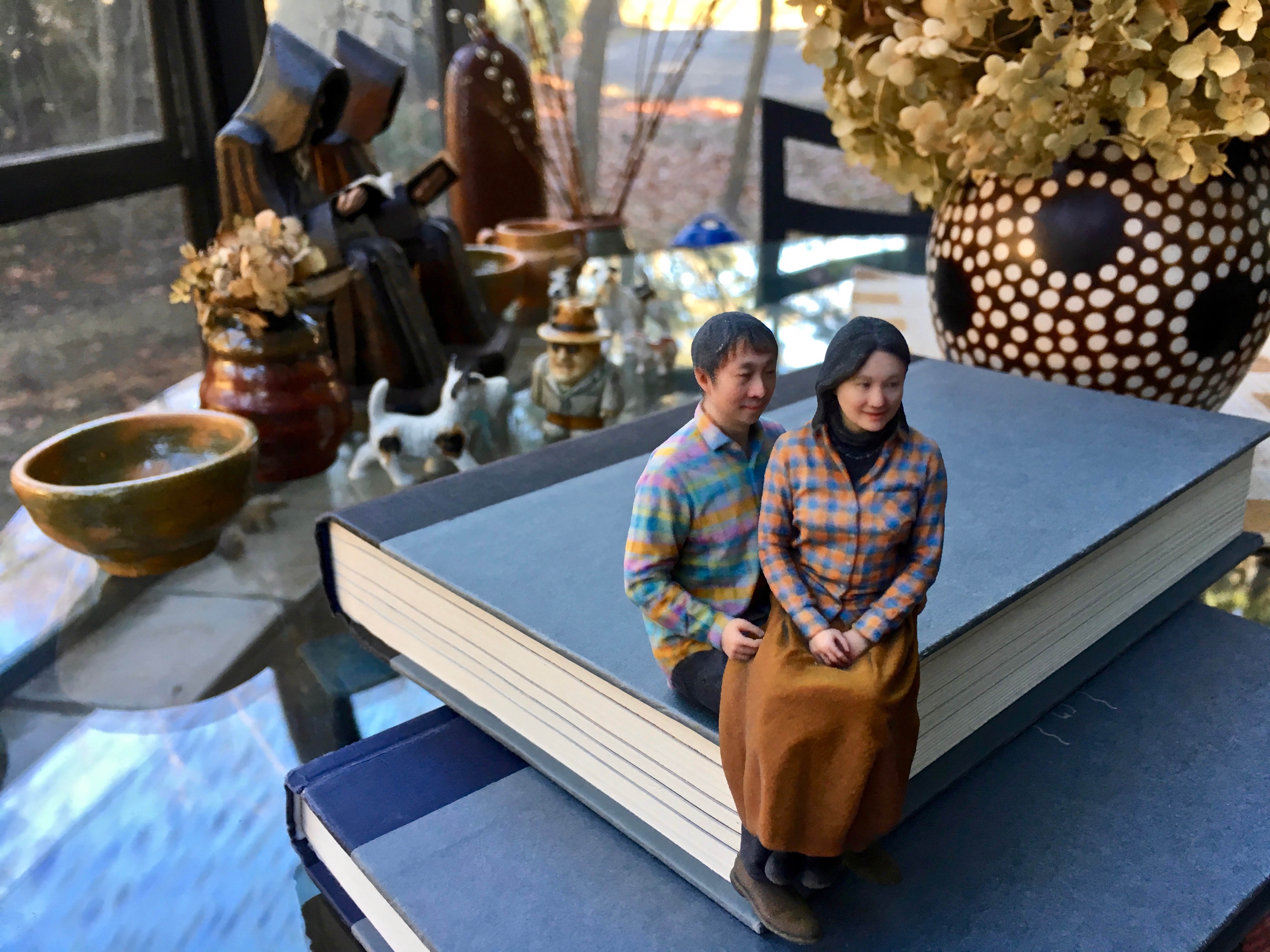
A 3D Selfie in 1:20 scale designed at Madurodam and printed by Shapeways
That seemed like a lifetime ago. In between then and now, algorithms had been invented to generate 3D models of people in color and with great details, all from simple 2D photos. But it is only in recent years that such technologies started to become commoditized. Just a month ago, Elisha and I stepped into, for a few seconds, a photo booth the size of a restroom, at the miniature park Madurodam. Three weeks later we received an exquisite 3D selfie printed by Shapeways.

Where is Waldo? Find the 3D figurines on the coffee table next to the cello
One can be forgiven for thinking that the two 3D figurines in the close-up appear to have been given blurry faces. Look at this picture of the living room, and think again. Those figurines stand only 3.6 inches tall. They are on the coffee table next to the cello, and are guarded by the mouse in a funny hat holding a candy cane. They are tiny, and the resolution of facial lines is stretching the limits of gypsum-based 3D color printing.
Continue reading →











 Xinhai Dude