
I enjoy writing about things I can’t find online. Here I wrote a snorkeling guide to Hanauma Bay for those of us that must obsessively research before our trips. I wish someone had written one before my trip.
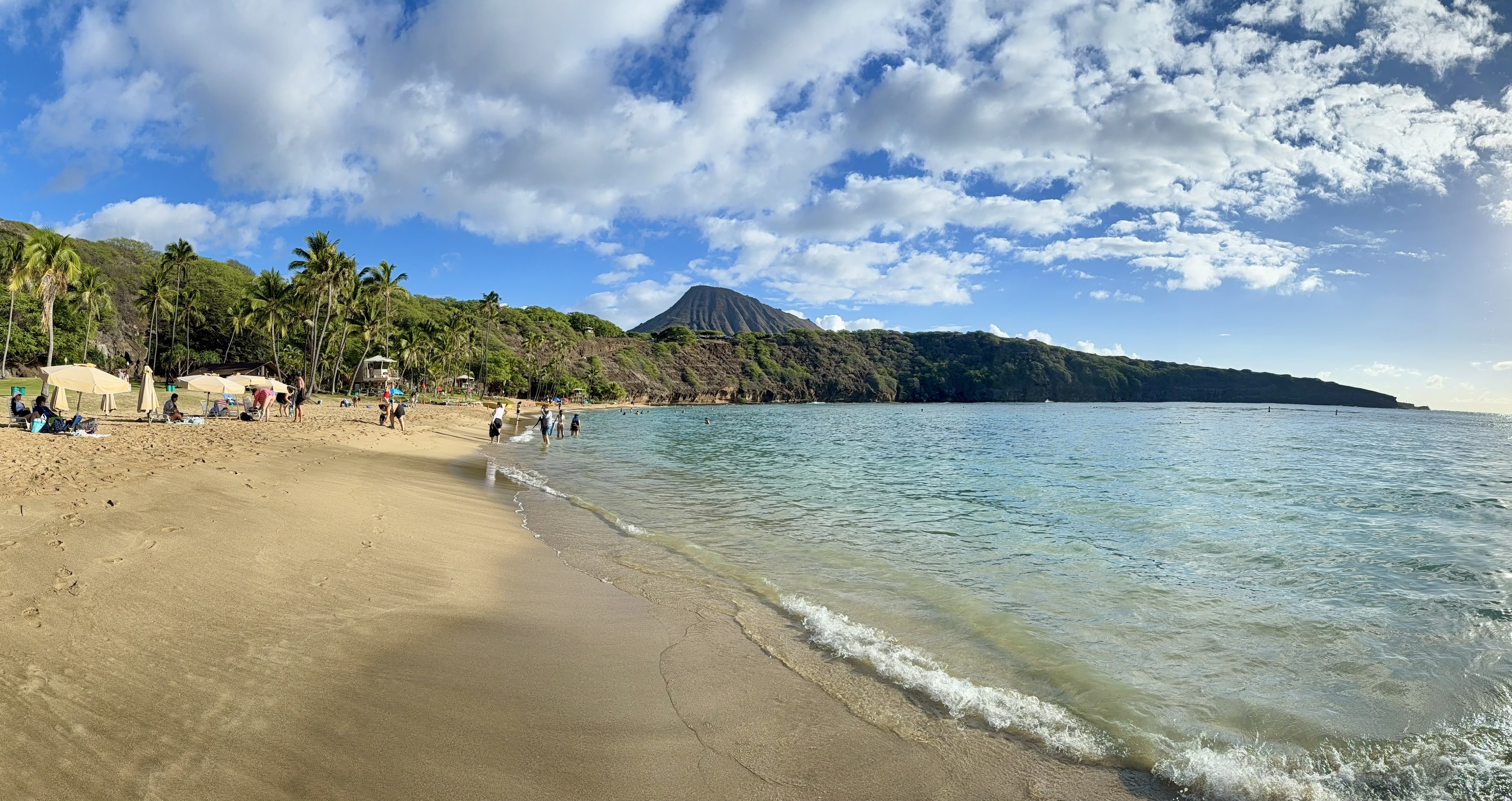
This essay would have been much longer if I had not stumbled upon Jordan’s travel blog on Hanauma Bay. You should take a detour and read it first. Watch the narrated video at the top of his blog. Scroll down to look at pictures and accompanying descriptions. He covers almost all basic questions a normal person may ask, including hours, booking a reservation, paying for it, driving to the bay, parking, renting snorkeling equipment onsite, and fish you will find. The blog includes great pictures showing what you may see. You’ll also find majestic views that you unfortunately won’t see in person, unless you were a bird or a drone.
Jordan’s narrated video is also available on YouTube. Go like it and subscribe to his channel. Also read the FAQs on this semi-official website. Find documentation from the park itself which answers even more questions. Come back if there are still unanswered questions on your mind.
If you are still reading, then I assume you are one of us, the chronically-overprepared. Here is a list of additional questions I tried to answer before my trip.
- Names of things at Hanauma Bay
- What beach activities are best at Hanauma Bay
- Where within Hanauma Bay is it safe to snorkel
- When to Snorkel at Hanauma Bay
- How to secure a reservation before they sell out
- Renting Snorkels at Hanauma Bay
- Rinse station, changing rooms and restrooms
- Renting beach umbrellas
- Fish you may see at Hanauma Bay
- At what time do I show up at the gate
- Daily attendance at Hanauma Bay
- Book reservation 2 months before your trip
- Alternative snorkeling venues
Names of things at Hanauma Bay
Geographically, Hanauma Bay opens out to the Pacific Ocean eastward. In the morning the sun raises on the East, lighting up the entire bay. In the late afternoon, a high cliff shades the beach from the sun, now on the West.
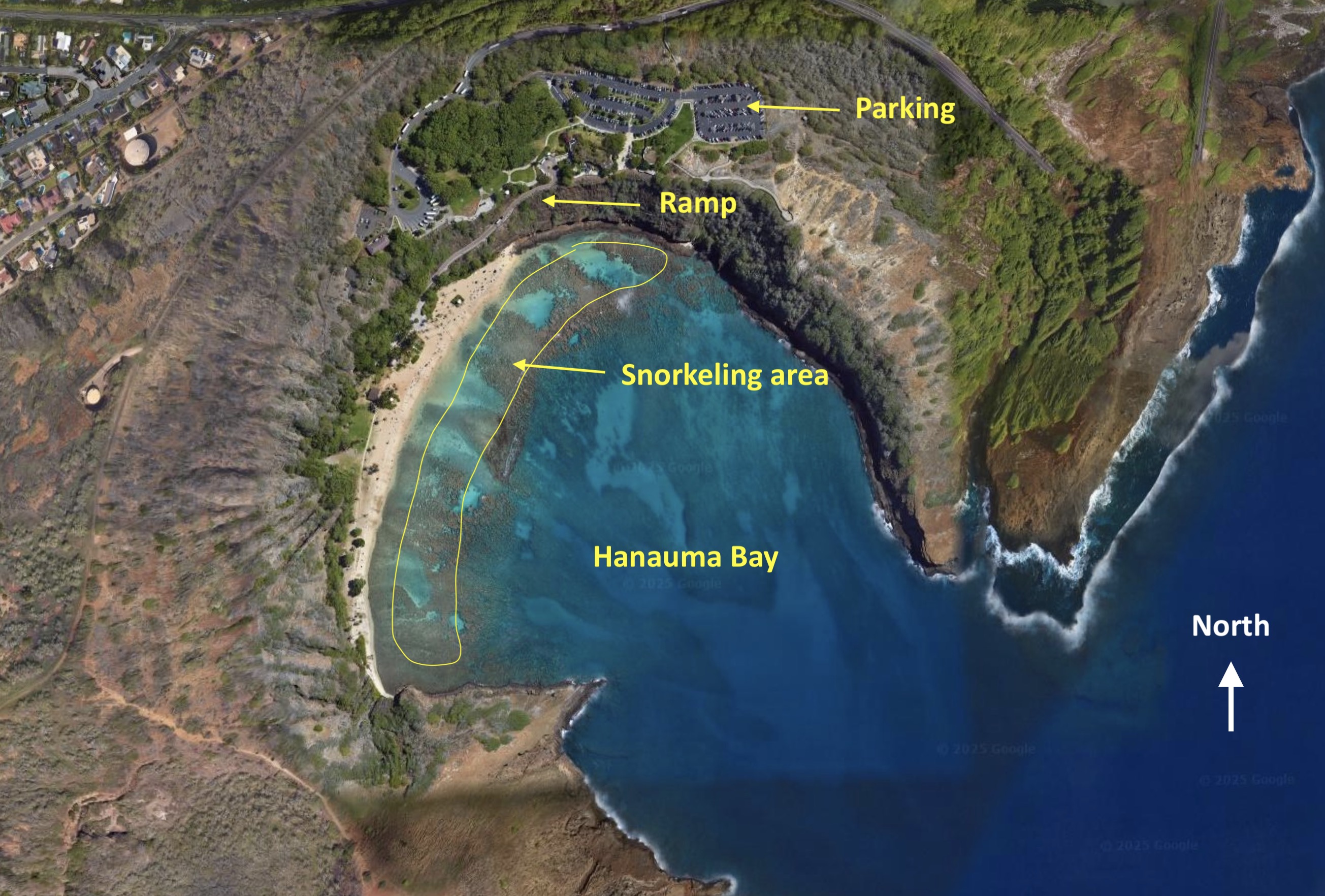
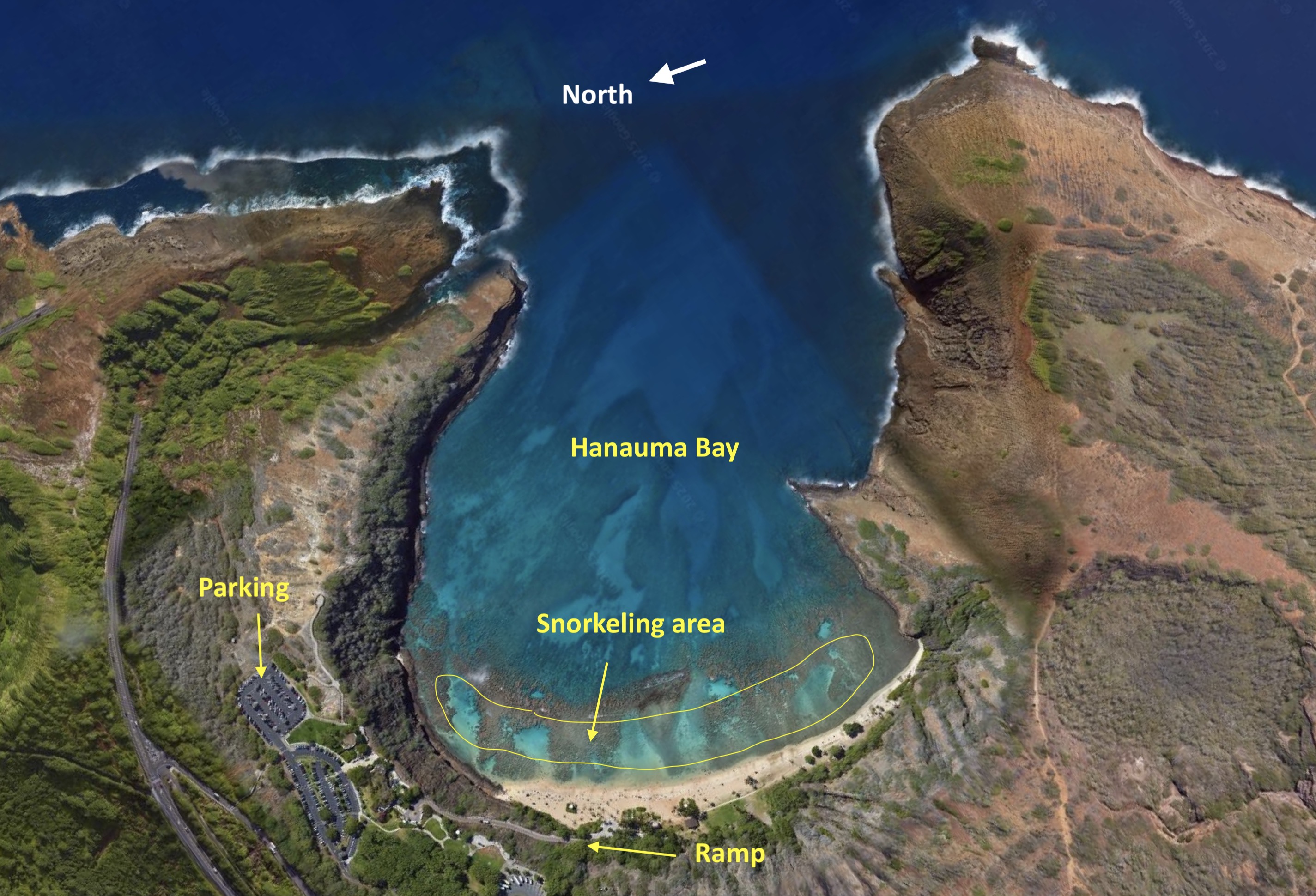
Locals refer to features within Hanauma Bay as being on the “left”, “middle” or “right”. This could be confusing unless you realize that official maps of the bay is oriented with the mouth of the bay facing up. This matches a snorkeler’s view as one stands on the beach, looking out towards the snorkeling area.
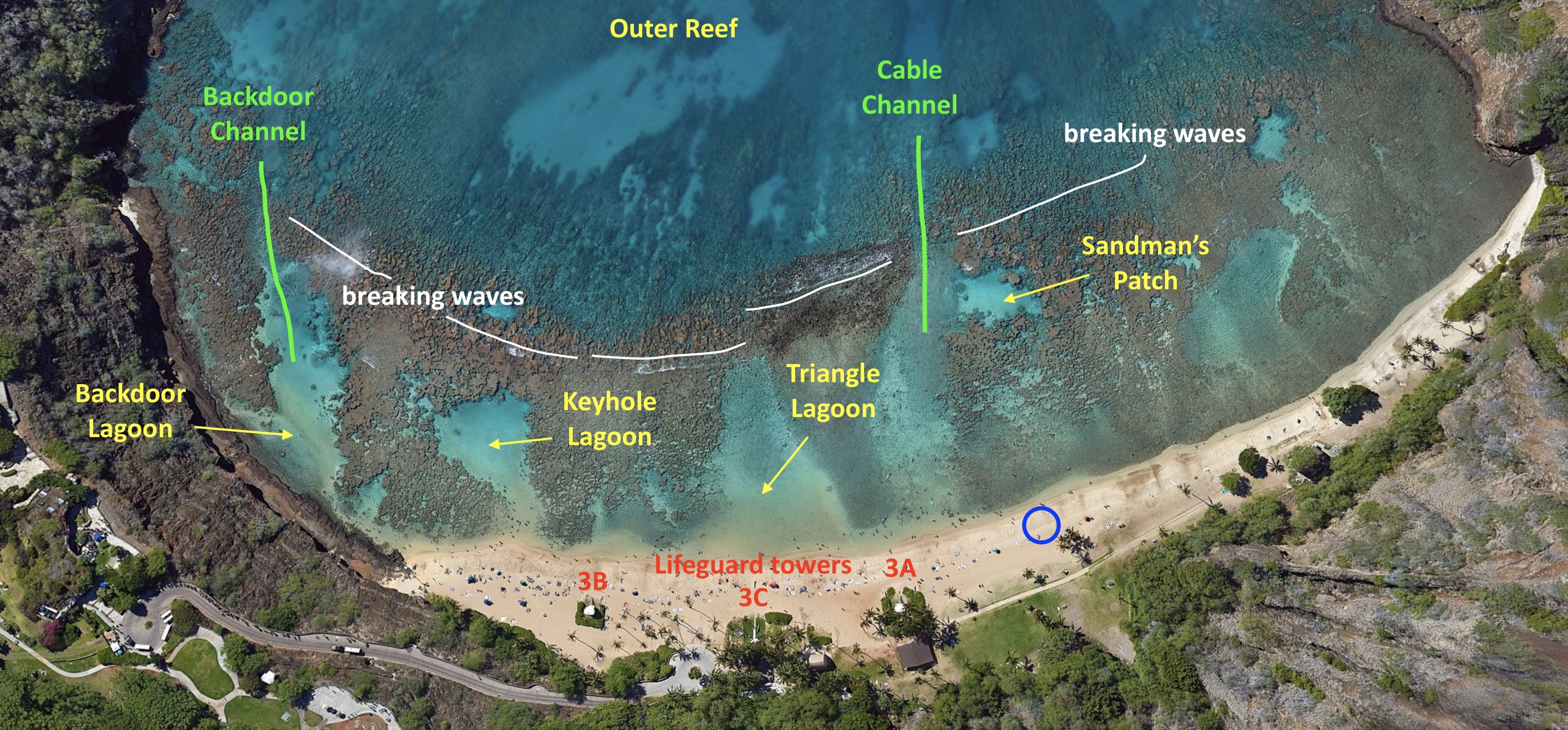
Here is a map showing key snorkeling features at Hanauma Bay, including Triangle Lagoon, Keyhole Lagoon, Sandman’s Patch, Backdoor Lagoon, Cable Channel (aka the Slot), Backdoor Channel, lifeguard stations 3A, 3B, 3C, and breaking waves.
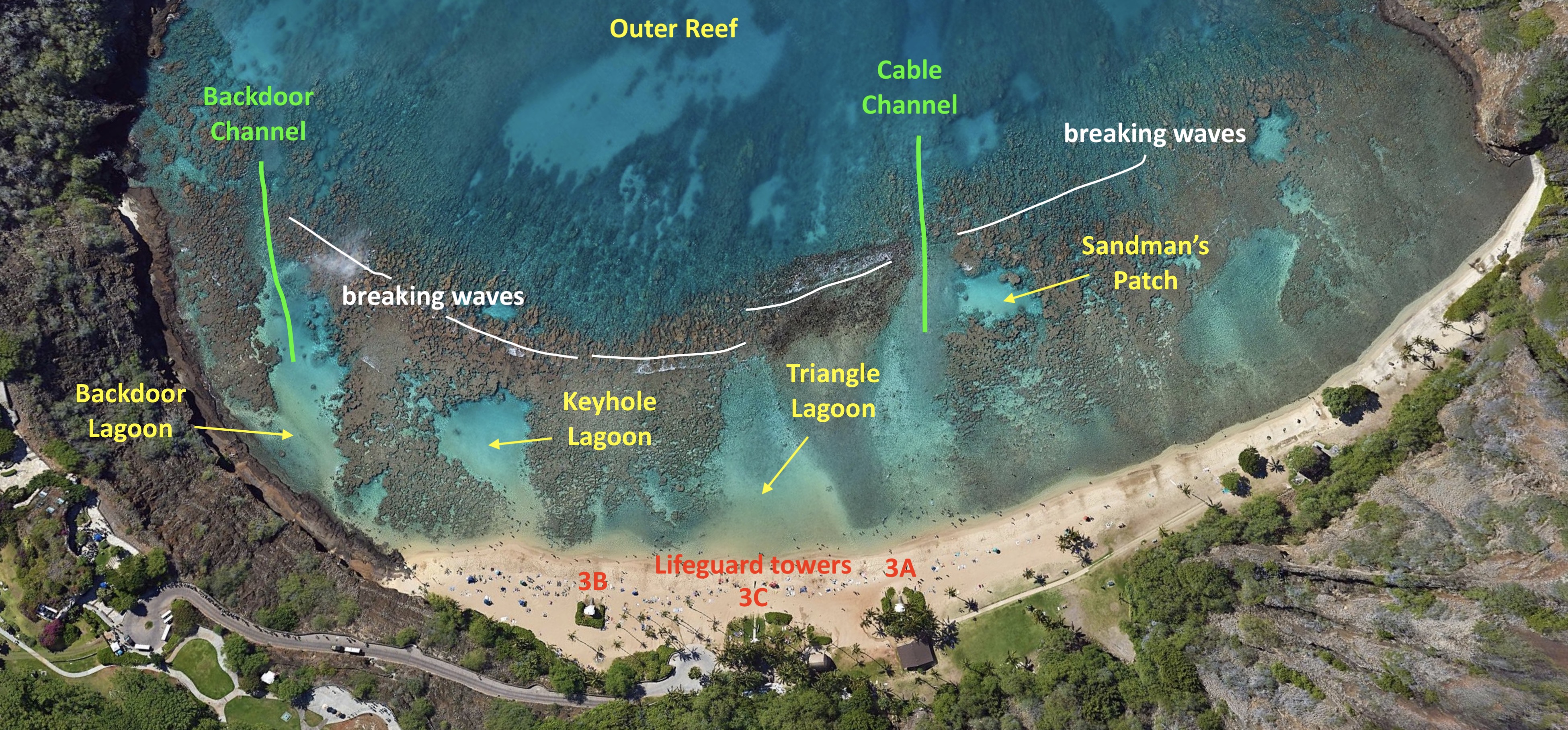
I believe this map is the most accurate you will find online. Even semi-official maps and reports such as this and this misplace labels or omit details. I looked up authoritative sources such as this, this, this, this and this to help confirm proper names and locations of these features.
So, when locals tell you to snorkel on the left side to see more fish, they mean the area between Keyhole Lagoon and Backdoor Lagoon. Here is a Google Earth link to see this view. Use this link if you prefer Google Maps.
Waves break when they reaches the reef crest marked in white. The two channels marked in green indicate gaps in reef which allow water to drain out, creating rip currents that can be dangerous, especially at low tide. If you swim into a channel, its rip current could transport you out into the deeper part of the bay. The Cable Channel, also known as The Slot, is the primary channel, named after submarine communication cables under that area. The Backdoor Channel is thus named for being a sidekick to the primary.
Lagoons and patches refer to coral-free areas covered by sand. It was said that military personnel in WW2 dynamited coral away to create the Keyhole Lagoon for swimming.
The unnamed patch of sand and rock rubbles between Cable Channel and the beach has a complicated history. That whole stretch of reef was dynamited away in 1956 to lay down the first transpacific telephone cables between Hawaii and California. There used to be a trench there, but that was covered up with imported sand in 1970, leaving what you see today. See official account.
What beach activities are best at Hanauma Bay
You can definitely swim in one of several lagoons at Hanauma. As mentioned, at least one of them was man-made with dynamites. These lagoons are shallow and relatively safe, thanks to the wave-breaking function of the outer reef crest. But there are no fish to be seen within these clear sand patches.

But you didn’t wake up at 6:50am to secure a reservation, and pay $25 per person, just to swim at these lagoons. You can enjoy the same safe swimming experience at one of the two Kuhio Ponds at Waikiki, for free.
For the same token, you did not pay $25 to come here to sunbath. You can do that anywhere else for free. If you enjoy crowded company, go to Waikiki. If you want to escape the crowd, walk over to Kaimana, or bike to Ala Moana.
You didn’t come here to learn to surf. There is no surf within the reef crest. Better head to Waikiki instead; it’s perfect for learning to surf. If you are a pro, go to the North Shore in winter; but you already know that.
Don’t kayak here. You will find a safe haven for beginner kayakers at Ala Moana, again, for free. Or if you are adventurous, kayak out to the Kaneohe Sandbar.
Only one activity makes sense at Hanauma Bay: snorkeling around reef.
Honestly you won’t find world-class reef here. If you come with Great Barrier Reef-level expectations, you will be disappointed. But this is still one of the best spots for snorkeling on Oahu.
What you can expect to find is a large variety of fish in calm and relatively-clear water.
With that being said, you can also find the same fish elsewhere on this Island. You’ll see smaller versions in similarly calm waters at Kuhio Ponds, by their rock walls. You’ll be surrounded by larger schools of larger fish outside the ponds. Same is true throughout the Waikiki Marine Life Conservation District, including at the Queens Beach. More on this at the end of this essay.
Where within Hanauma Bay is it safe to snorkel
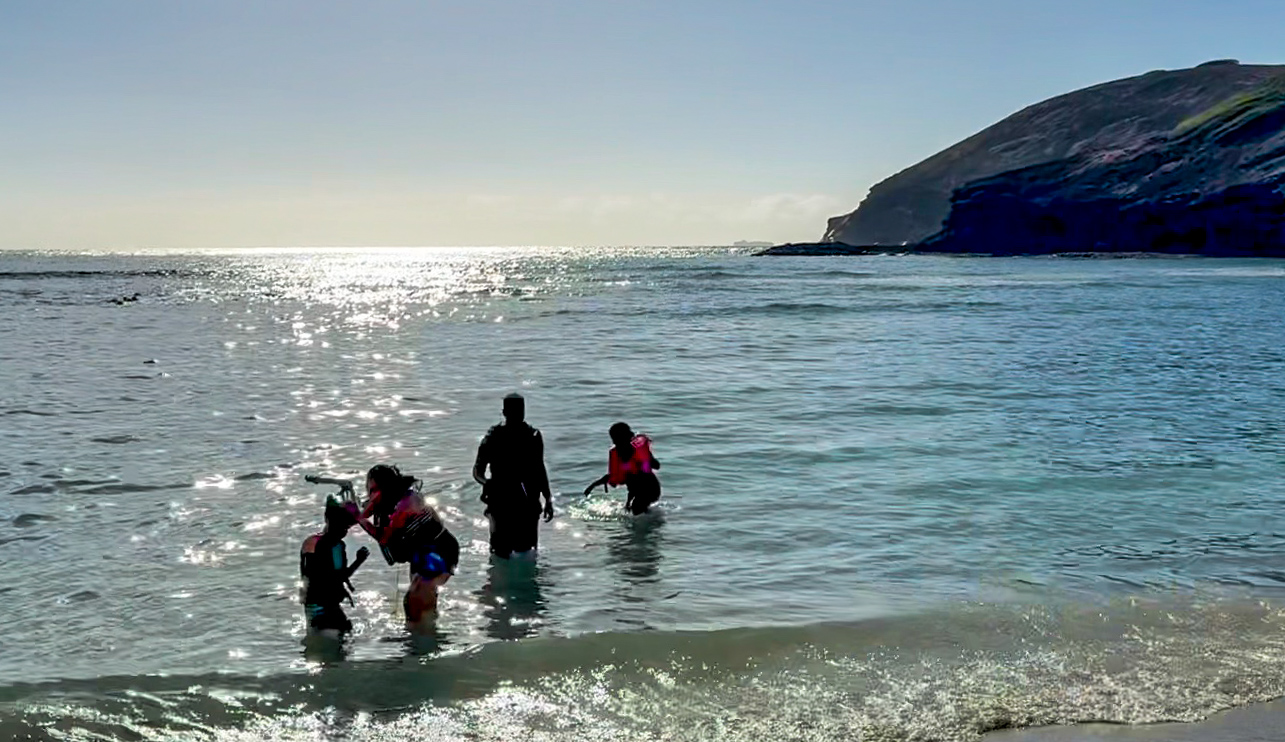
Watch this short clip to take in the view from the middle of Hanauma Bay’s long shore.
That’s your view when you stand at the blue circle shown below, in front of the Cable Channel and about 200 feet away from lifeguard station 3A.
A notice posted at the top of the ramp indicates areas with a strong rip current or a sudden drop of floor. This picture is, however, taken from an usual location atop the cliff. Its distorted view artificially inflates the right side of the bay.
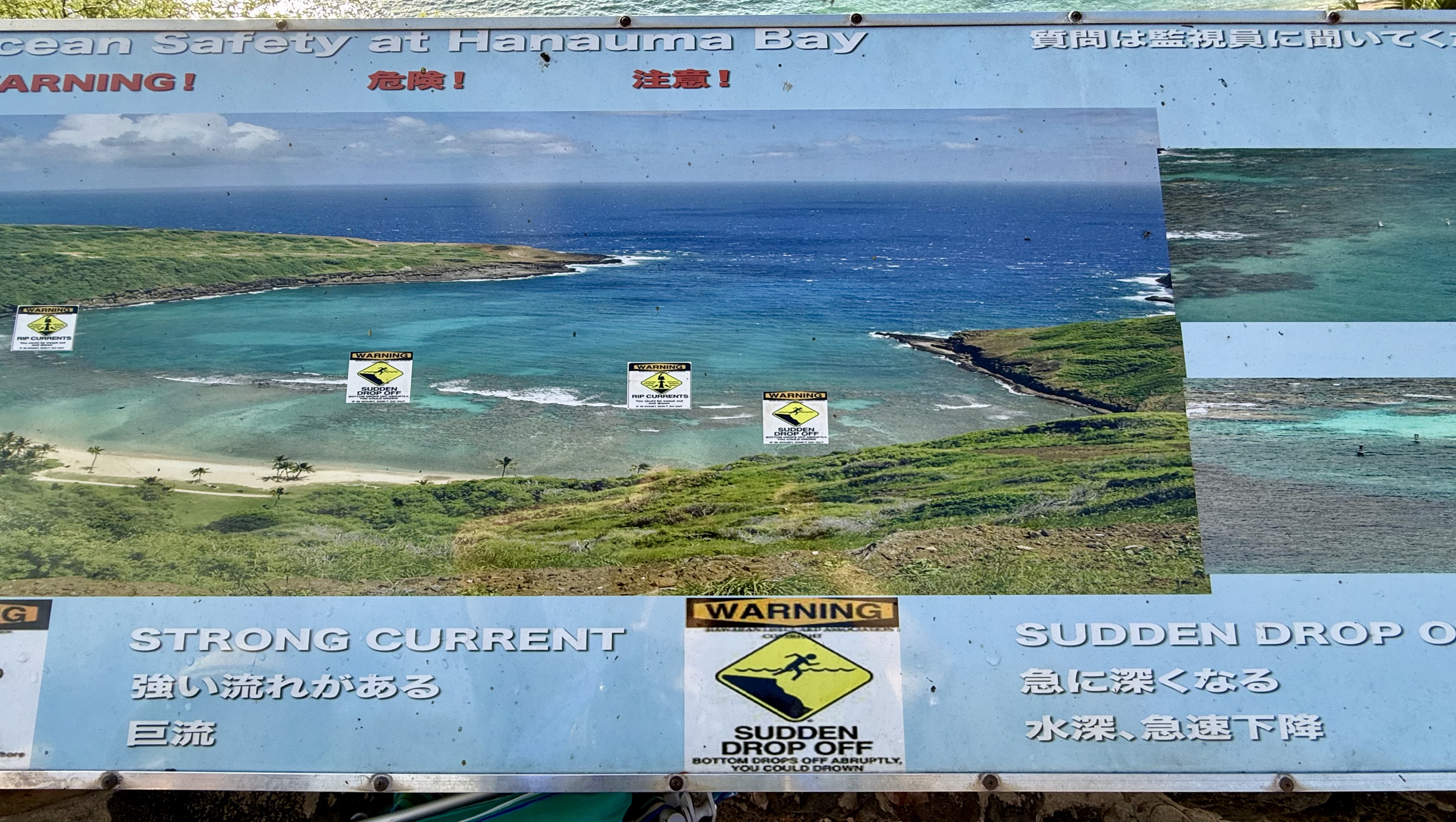
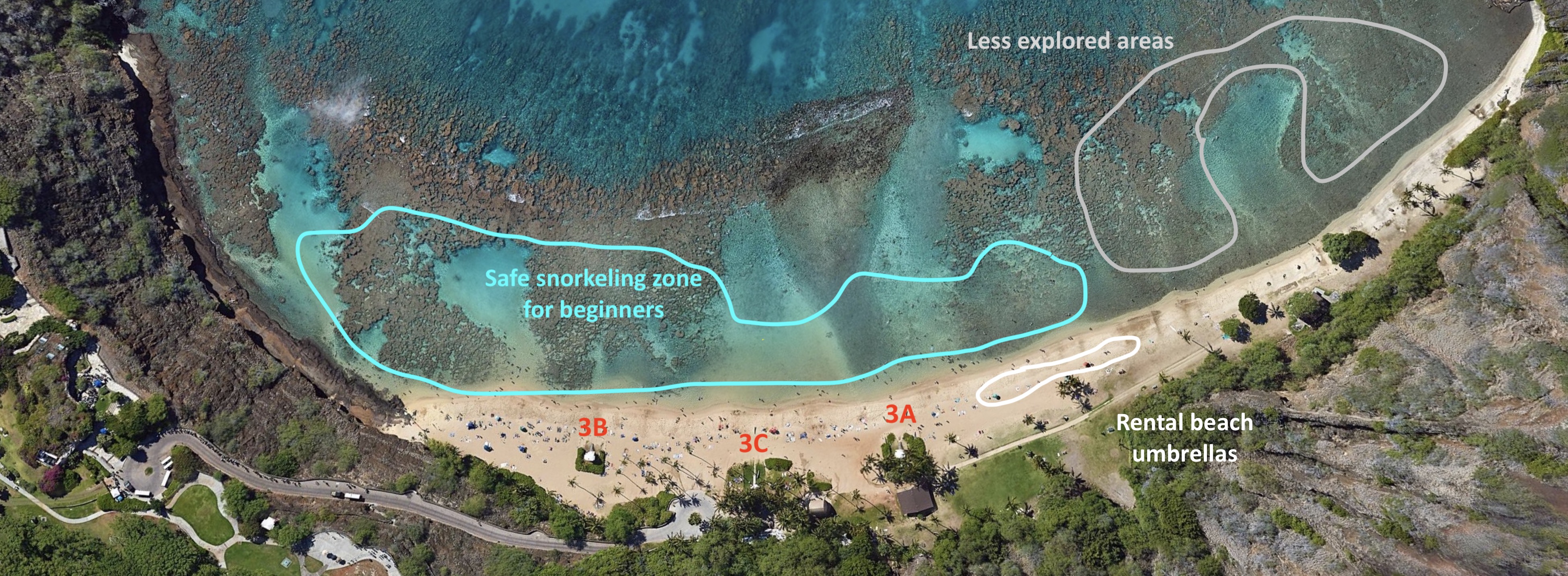
I reproduced this view on Google Earth for you. Then I marked on the following image the four dangers from the warning sign. I think the sign meant to show both rip current at Cable Channel and sudden drop off at Sandman’s Patch. I marked out safe snorkeling zone for beginners. Now, you will find snorkelers all around the bay, even beyond the reef crest. Those people are good swimmers, and know how to deal with rip currents and waves.

The next map shows the same safe zone in a 2D view without the perspective skew. This zone is well within visual range of the three lifeguard stations. According to a study from 2010, 63% of rescues occurred at Cable Channel alone. Other high-rescue areas include Sandman’s Patch (10.8%), Backdoor Channel (10.2%), and a part of Triangle Lagoon (9.5%). Avoid these areas. There are presumably buoys near Cable Channel and Backdoor Channel to warn you. But I don’t recall seeing them myself. I probably never swam close enough to see them. That was wise. A self-pat on the back.

I wore my kayak life jacket with a high back when first jumping into Hanauma Bay, because I had no idea where it was safe to snorkel and what a beginner should avoid. That warning sign caused only confusion, because no one at the beach could point out where those dangers were.
Even the marine biologist giving a talk behind the information booth couldn’t (or wouldn’t) show me where to find safer snorkeling areas. He kept repeating, “you know, there is always a risk when going into the water. Some people drown, you know.”
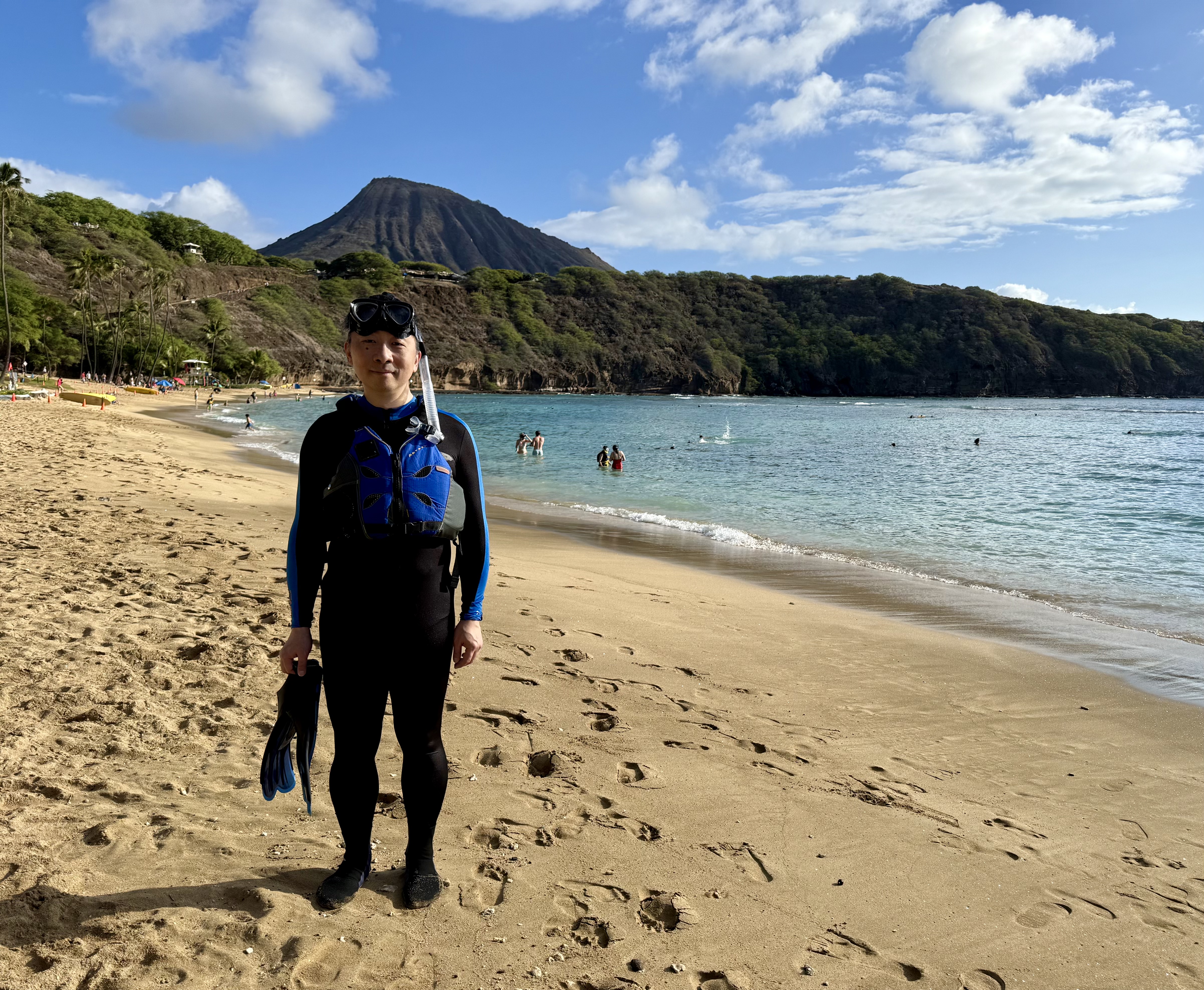
That kayak life jacket made snorkeling very uncomfortable. But it did make me feel safer as I swam all around the reef. Once I understood the underwater terrain, I grew comfortable snorkeling without the life jacket.
In general, you will not see fish when swimming above clear patches of sand. But those clear lagoons are useful for a beginner to get to know one’s snorkeling gear. Start at the Keyhole Lagoon; it’s shallow and calm. Make adjustments to your mask strap to ensure a good mask fit, without any leaks. Even a small leak washes away your defog, making it hard for you to enjoy the experience, as I explained here.
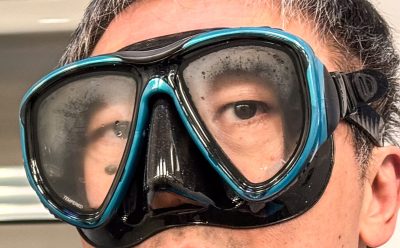
Then you can venture closer to an edge of a reef. You will see a lot of fish at the edge. If it’s mid tide to high tide, you can snorkel comfortably above the reef.
Everyone told me to snorkel on the left side – there are more fish to see there. That includes reef around Keyhole Lagoon and Triangle Lagoon. I can confirm that now.
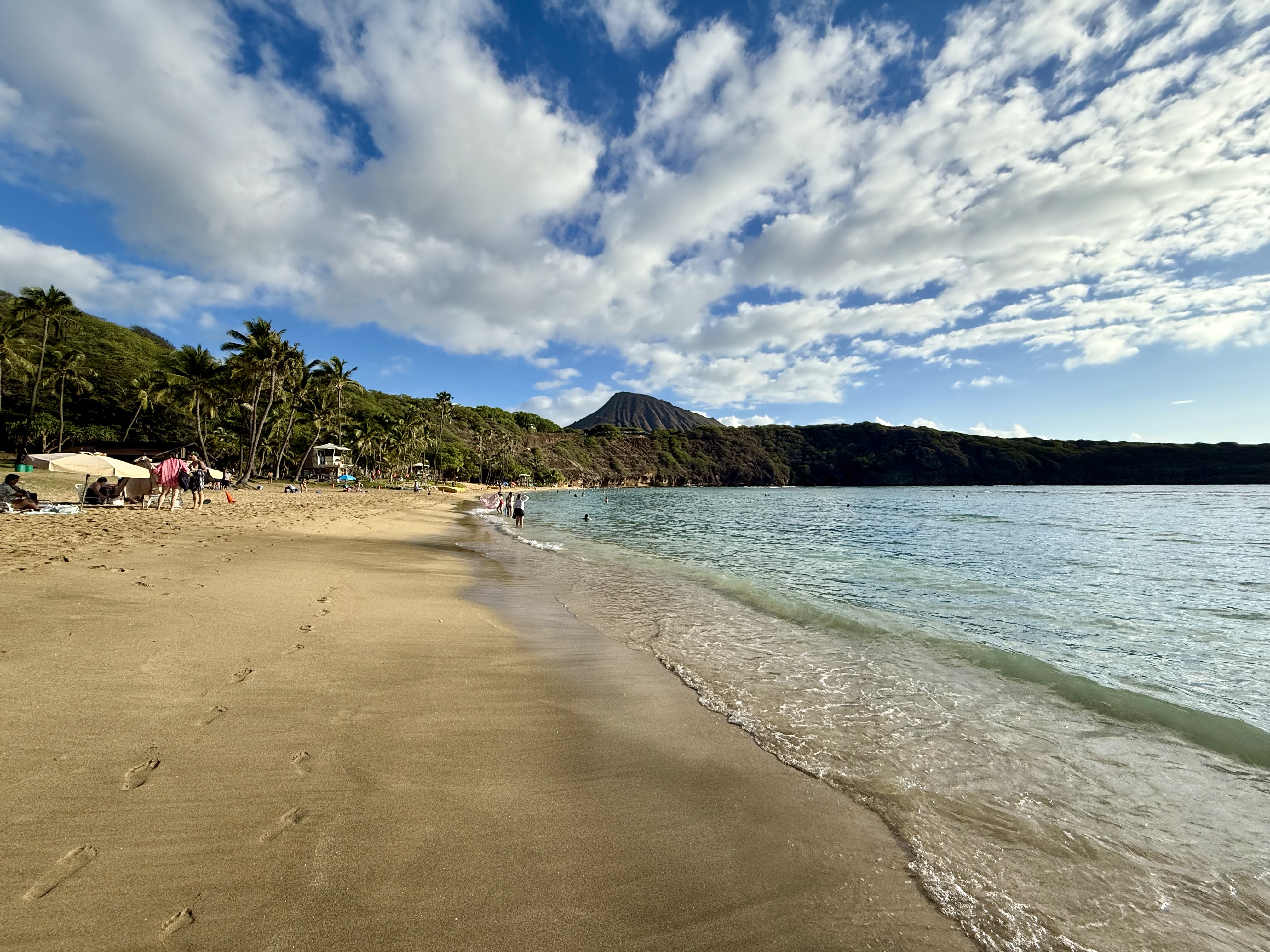
There were few fish between Cable Channel and shore – I saw mostly scattered rocks. Water is murkier as well. Recall that you are looking at a still scarred landscape from human actions in the 1950s.
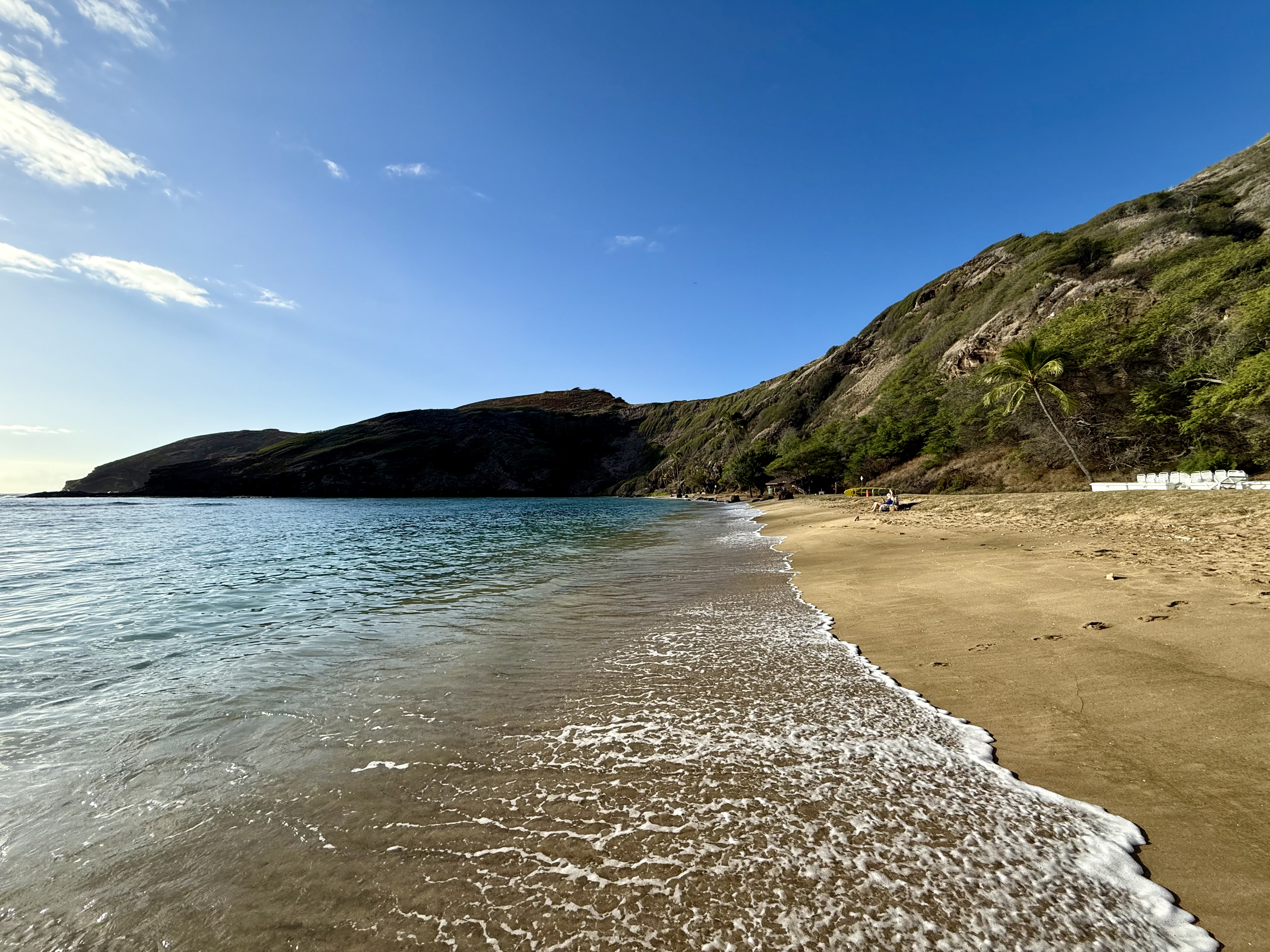
Very few people snorkel further to the right. Perhaps it’s safe to snorkel all the way to the right. I don’t know whether snorkeling conditions improve further to the right. But there are no lifeguard stations out there, and there are few fellow snorkelers around to raise alarms should you get in trouble. I have a suspicion that locals and conservationists want to dissuade tourists from further devastating fish population on that side.
When to Snorkel at Hanauma Bay
Shade is scarce at Hanauma Bay. The sun rises in the east, shining unobstructed into the bay, and the few palm trees at the beach cast shadows too far away to shade you. As the sun rises, the tree shadows keep shifting. But you can’t always move with them; people have already claimed the new shaded spots. The sun moves to the west by late afternoon, and the cliff can finally shield you from the sun. But by then the park closes.
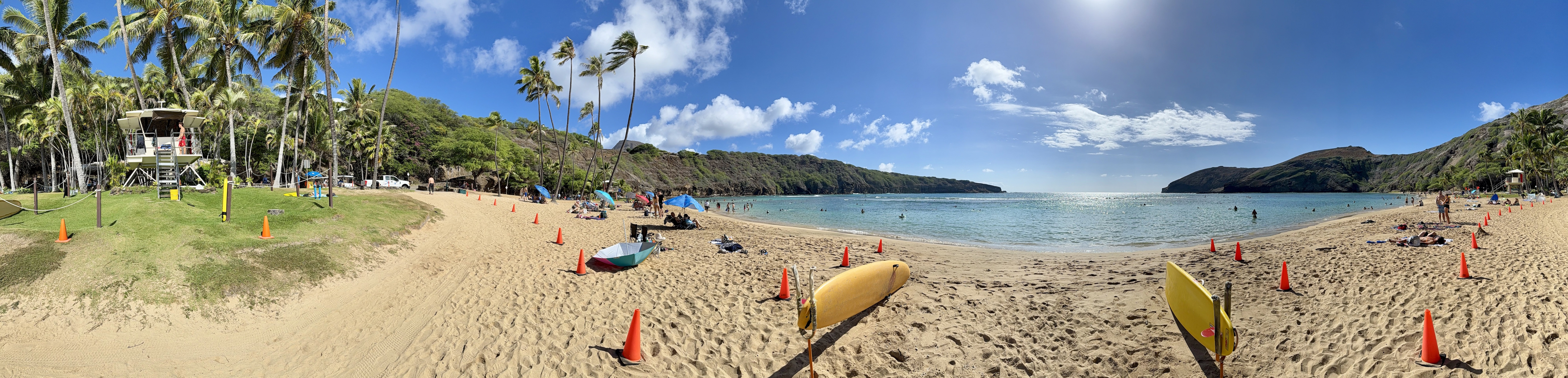
So, try to book the earliest possible reservation to avoid harsh midday sun, and the crowd. The first reservation slot is for 7am. You can bring your own beach umbrella. But I recommend renting one onsite. More on umbrella rentals later.
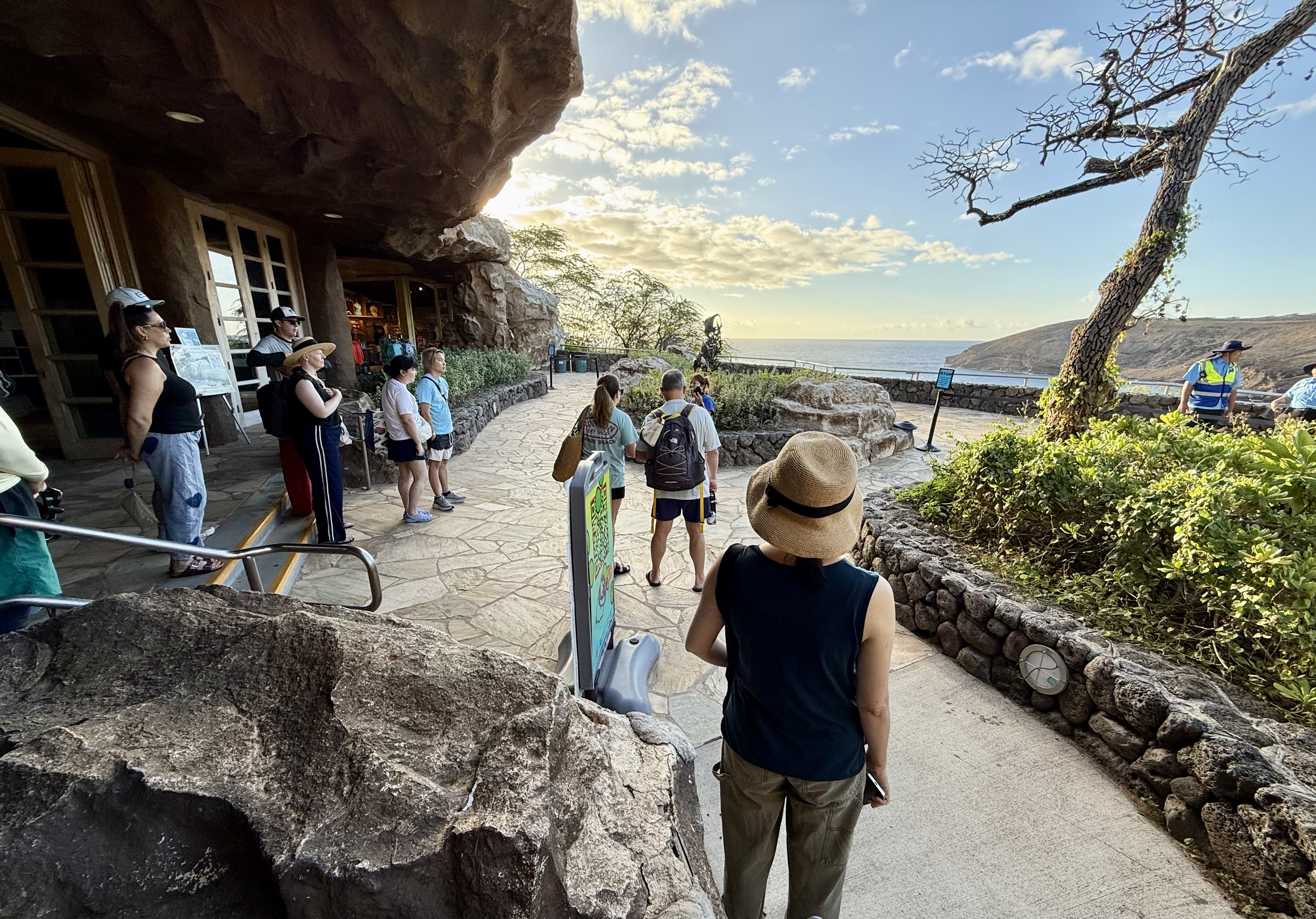
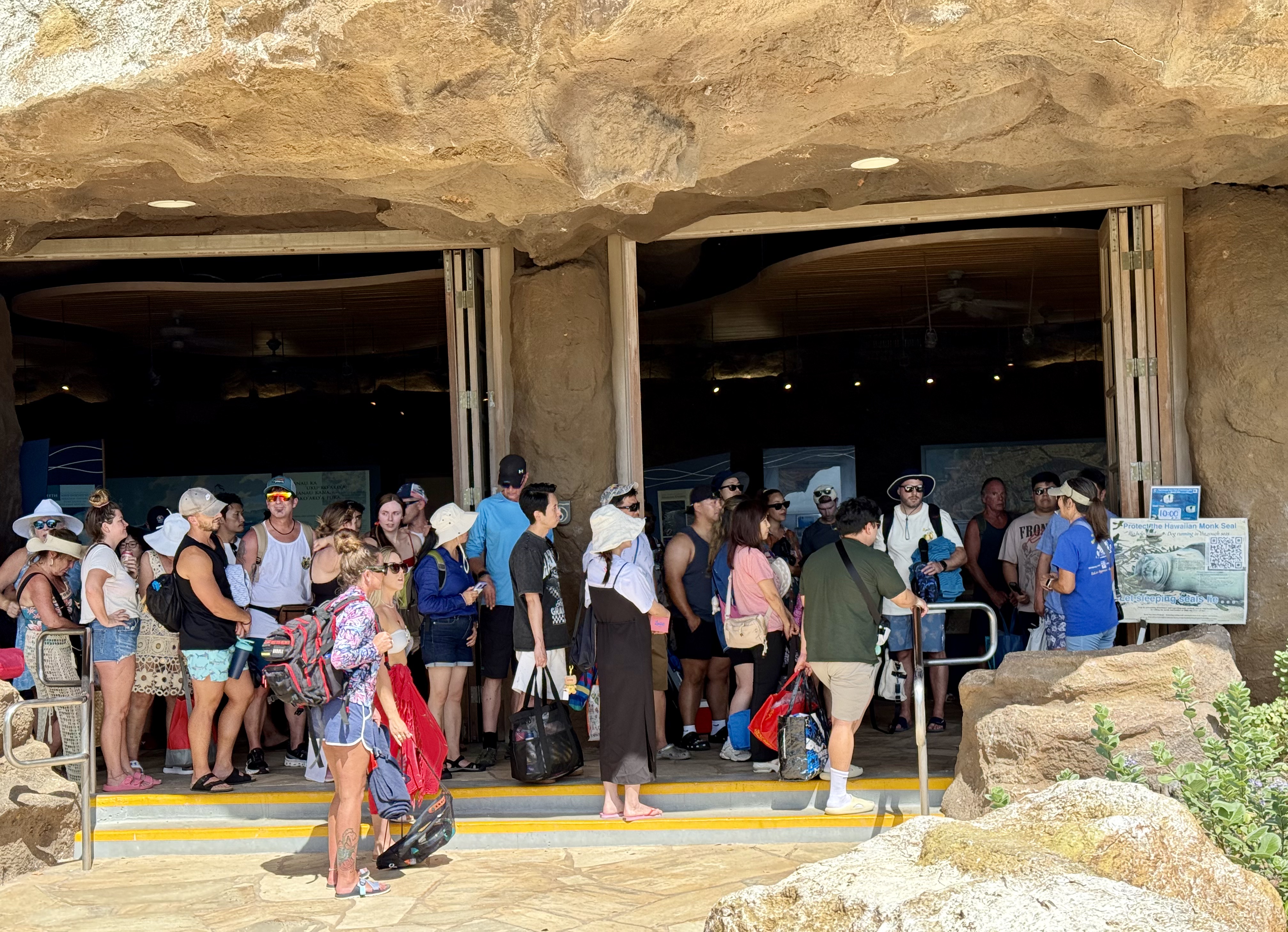
If you have a choice, try to visit the park from mid to high tide. You can comfortably snorkel atop reef; and rip current is a lesser concern at the channels with a rising tide.
You may want to avoid the crowd on weekends. And the bay is closed on Mondays and Tuesdays. That leaves Wednesday through Friday as top choices for visits. It also means you will want to wake up before 7am from Monday through Wednesday to book reservations.
Unlike the North Shore, Hanauma Bay seemed undisturbed by high surf that accompanied the rainy season in winter. At least that was my experience in November.
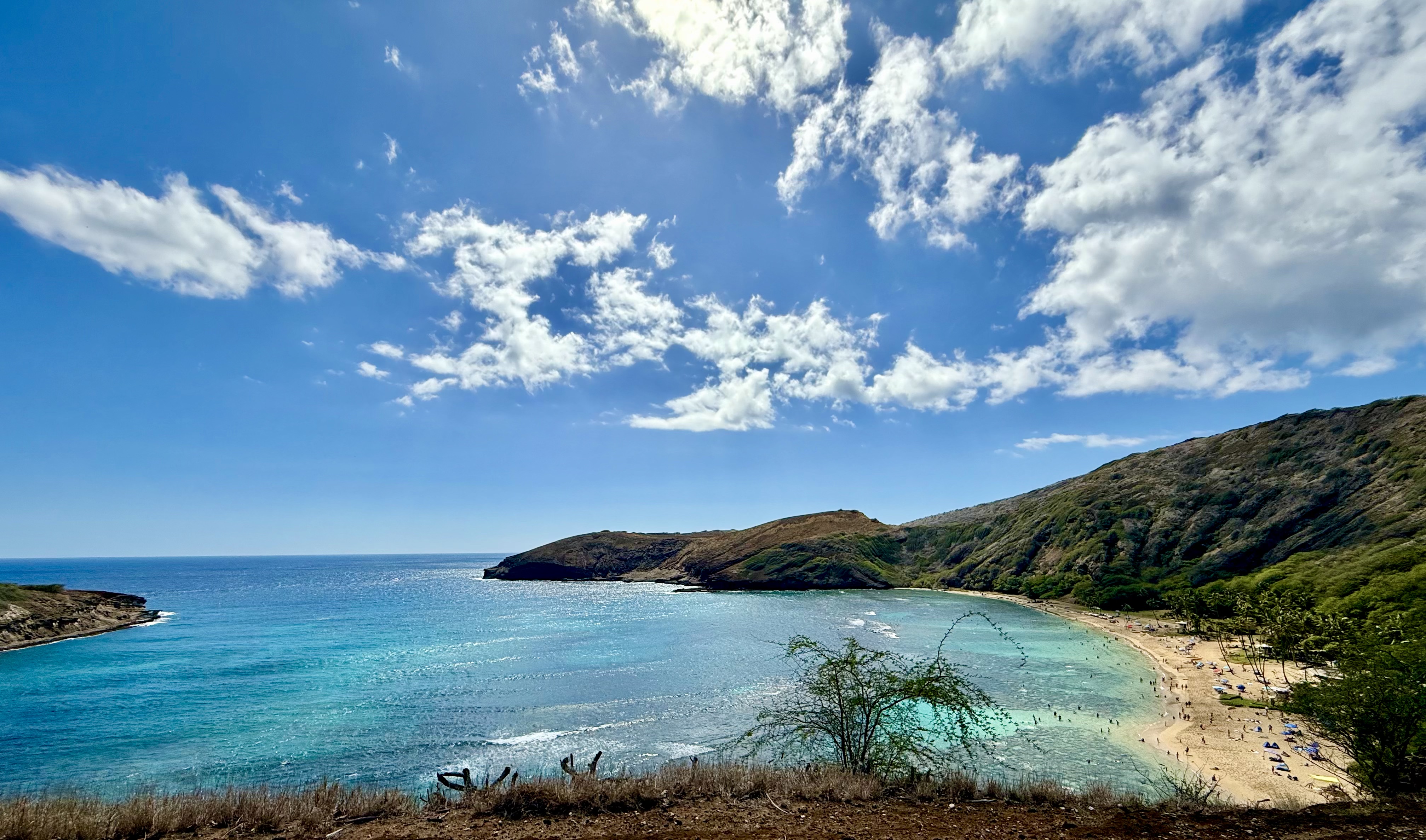
During the summer, reservations are said to sell out within 5 minutes. In November, I was able to secure an 8:30am slot by 7:07am. And when I looked at the reservation page again at 7:11am, slots 11am onwards were still available. On the day of my visit, I was able to find parking without issues. And the beach did not feel too crowded by noon. If you are able to, visit in shoulder seasons. But they said that water is slightly murkier in winter.
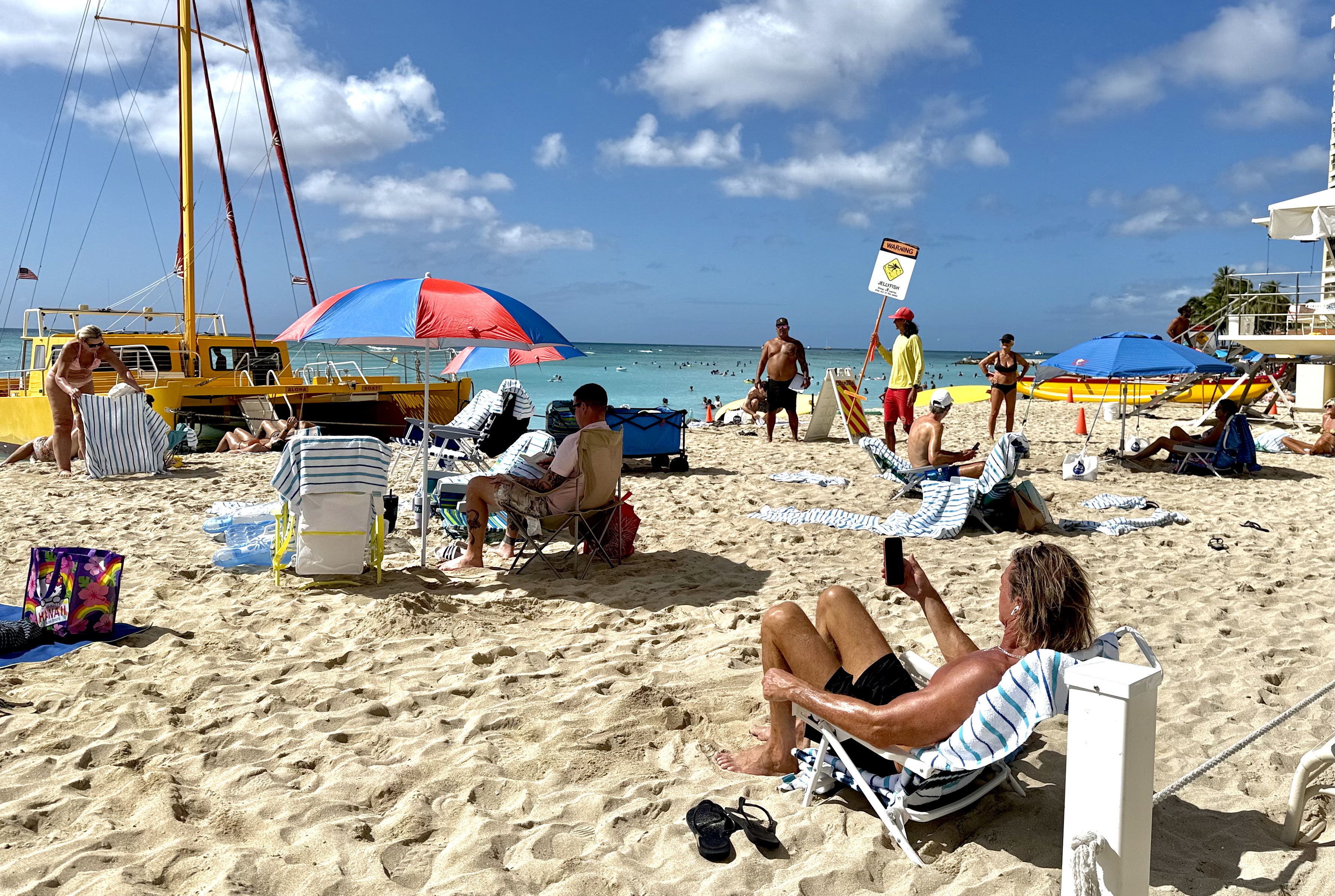
Box jellyfish come out 8 to 10 days after full moon. This may or may not be an issue. I saw lifeguards at Waikiki walking around with a Jellyfish warning sign, and nobody seemed to bat an eye. I’ve swam at Waikiki and Kahala on high risk days without issues. But I always wore neoprene socks, fins, and a full-body wetsuit. That left only neck and parts of my face uncovered. I read that lifeguards may close a beach if actual number of jellyfish is alarmingly high. But it hasn’t yet happened to me. Check with the Jellyfish Calendar.
How to secure a reservation before they sell out
It is said that all reservations are sold out within the first 5 minutes after the virtual gate opens at 7am each morning. At least that is said to be true for summer. I was there in November, and it took slightly longer for tickets to sell out on Wednesday 11/5, for Friday 11/7 reservations.
But boy, was it a nerve-racking experience. So I pulled up my phone at 7am, and found all slots available. I immediately booked the 7am slot, and tried to pay. But the payment failed to go through. I tried to fix my address, thinking that it wanted specific wordings for my address. But it turned out that I entered a wrong digit in zip code earlier. At some point, the system kicked me back to the home page because my chosen slot was sold out. I picked 8:20am with a few reservations still available, and successfully paid for two people. And it was already 7:07am. I took a look at the home page at 7:11, and found that you can only realistically book for 11am onward by then.
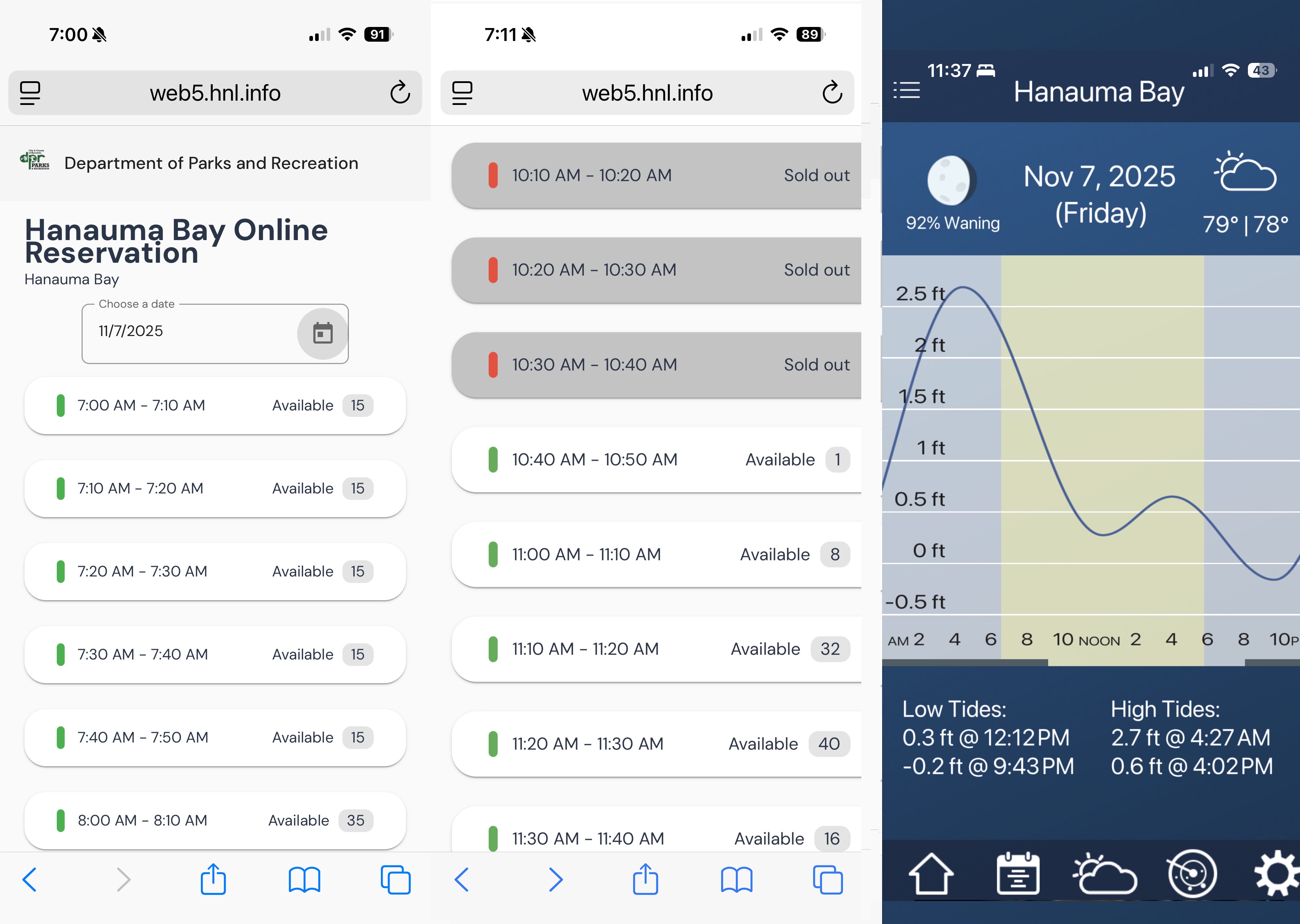
I looked at my simple tide app. It showed mid to low tide for the time I would be at the bay. That was not ideal. Most source indicate mid to high tide as a better choice. But that was the day I could make it out to the bay. And I counted myself lucky for having secure a reservation at all.
In retrospect, I should have “practiced” booking a reservation, the day before, just to see what the process looked like and what fields to fill in. I would take it all the way from choosing a slot to almost finish paying – without actually clicking on the last button to charge my credit card. Reservations cannot be canceled nor refunded once booked. I would practice on the same device I would use on the day I make a reservation. I would enable auto-fill, and ensure that auto-filled values are correct.
People on Reddit post their planned itinerary for r/VisitingHawaii to help revise. Often these itineraries show that visitors don’t know that they must book their reservations exactly two days before the visit. Some know this, but believe that they could somehow achieve this feat while on a plane across the Pacific Ocean. Others have taken into account all of the above, but forget that one must do this at 7am sharp, Hawaiian time.
If you failed to secure a reservation ahead of time, you can still try to walk in. Show up at the gate at 6:45am, and try to get a walk-in ticket for the earlier possible walk-in slot. All members of your party must be present to secure a walk-in ticket. The park issues hundreds of walk-in tickets a day. More on this later.
Renting Snorkels at Hanauma Bay
I recommend that you bring your own snorkeling equipment, including wetsuit and fins. Not only did I bring my own gear to Hanauma Bay, but I also had prescription lenses to go with my snorkeling mask. This way I had total control over my snorkeling experience. The only things I recommend renting onsite are beach umbrellas and chairs.
If, however, you must rent equipment at Hanauma Bay, then rest assured that they’ve got everything you need covered. This includes: snorkel, mask, fins, life jacket, wetsuit, beach umbrellas, chars, and locker boxes. They incredibly stock prescription lenses too.
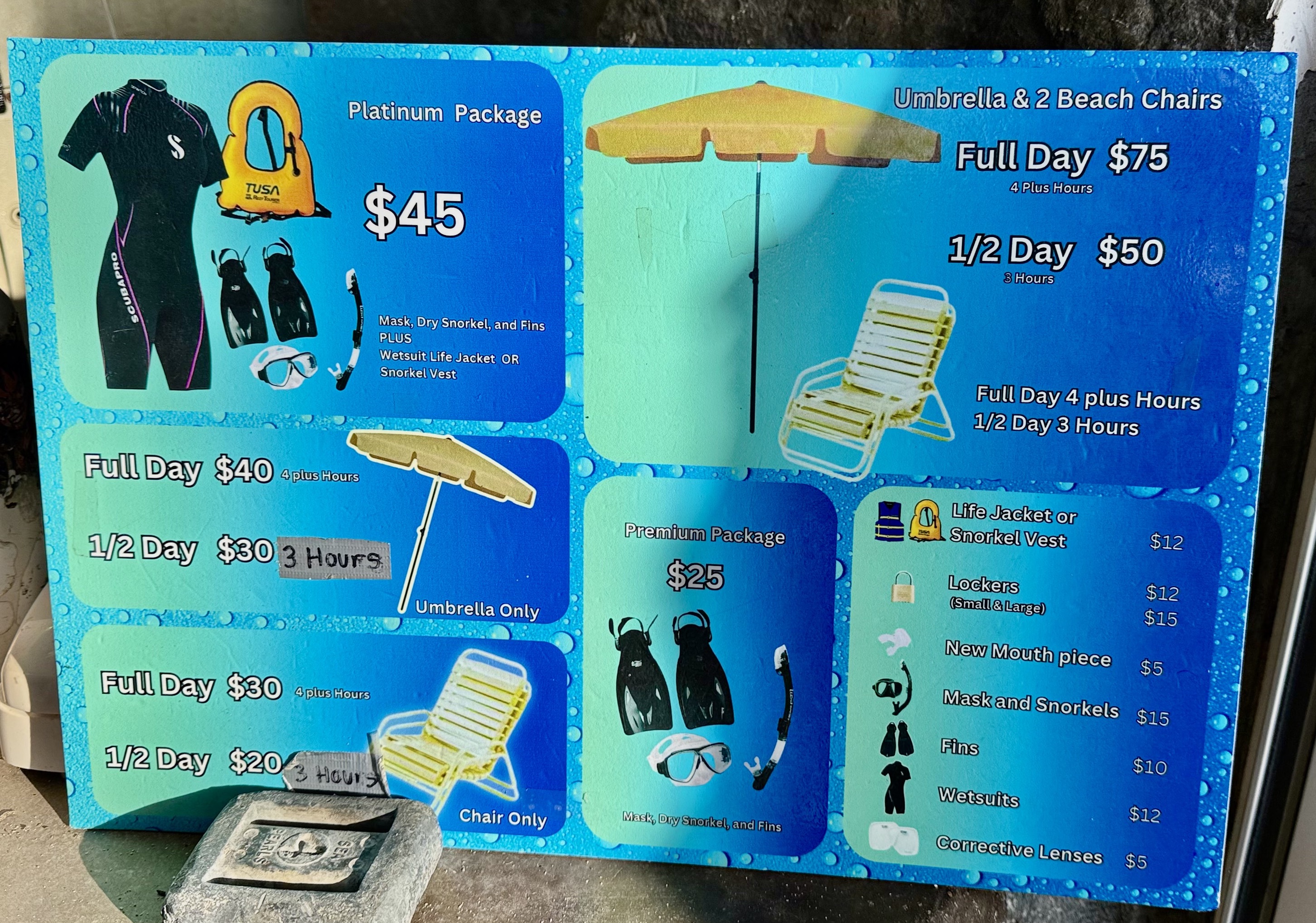
If you need to rent here, you should plan to show up early. Here is the rental place at 8am.
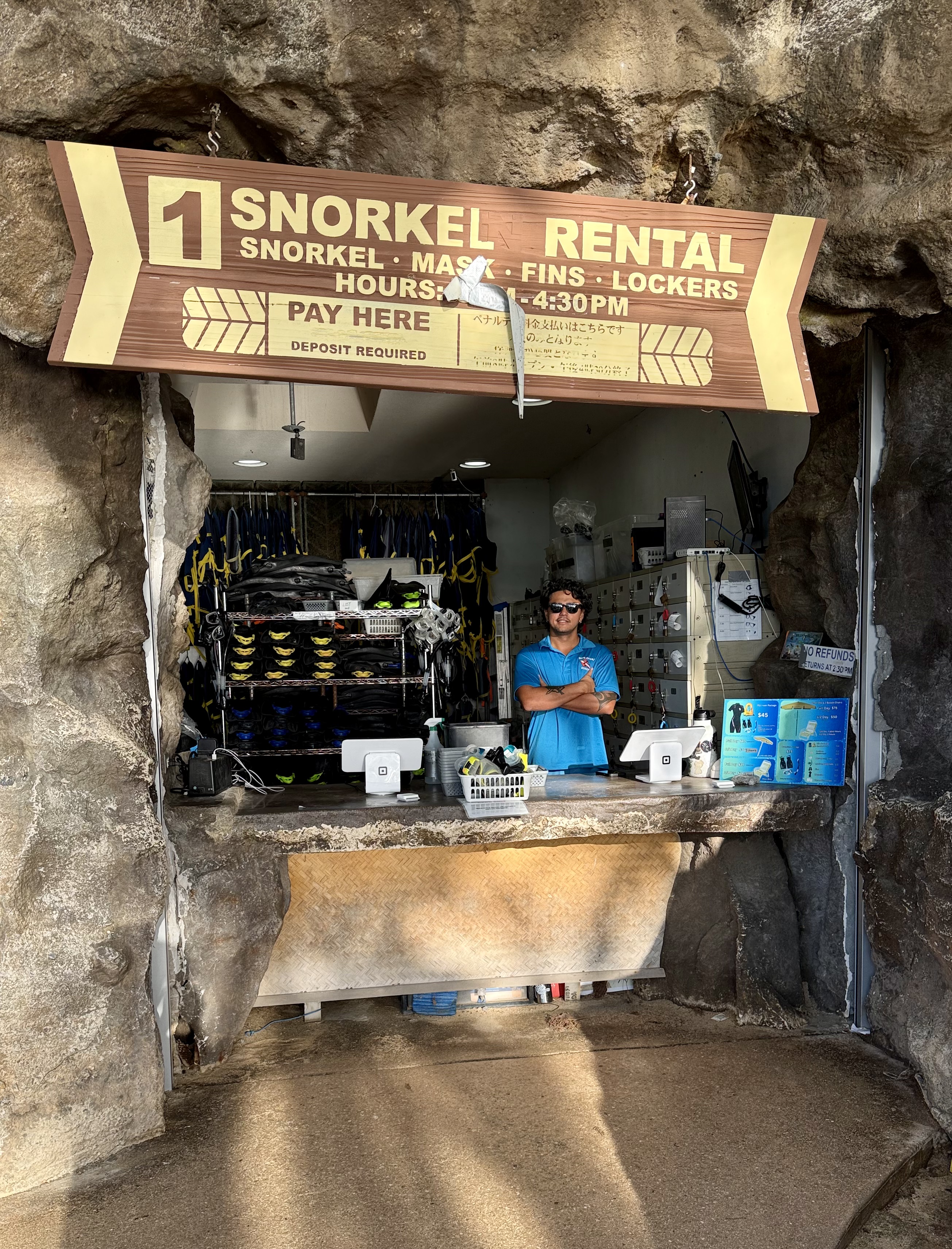
This is the same place at 10am. It is yet another reason to bring your own equipment. And if you do bring your own, you will have to take care to properly apply defog. If it’s your first time, read this post on defogging, because I saw too many tourist wiping their masks in the middle of snorkeling here.

You have to admit, they built this structure right. It looks cool and fitting.

Rinse station, changing rooms and restrooms
The outdoor rinse station is located behind lifeguard station 3C. Once you rinse off with the shower and the foot wash, there is no sand between you and the walkway to the ramp.
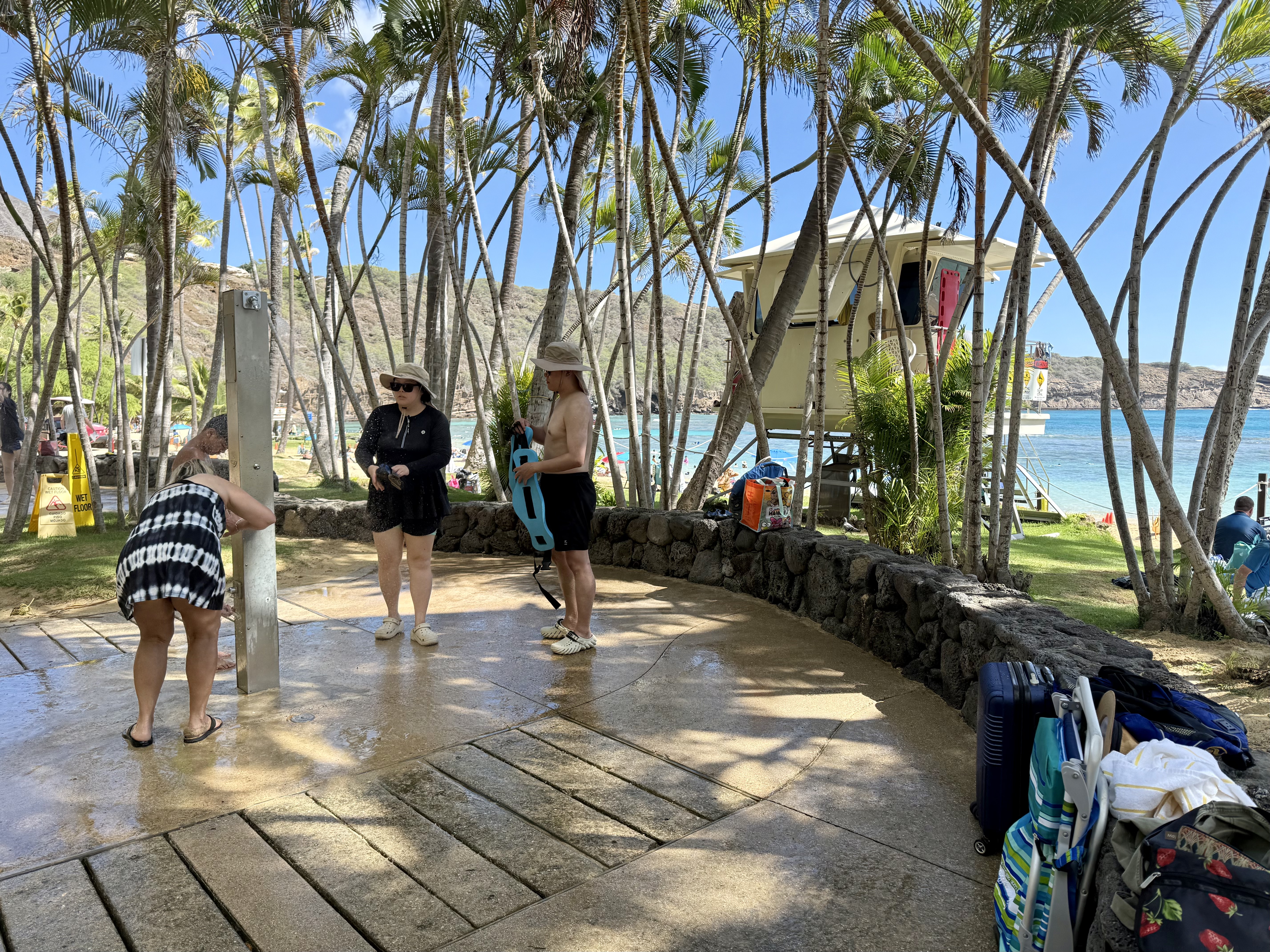
There is a changing room and restroom right next to the rinse station. It’s housed within the same structure as the gear rental.
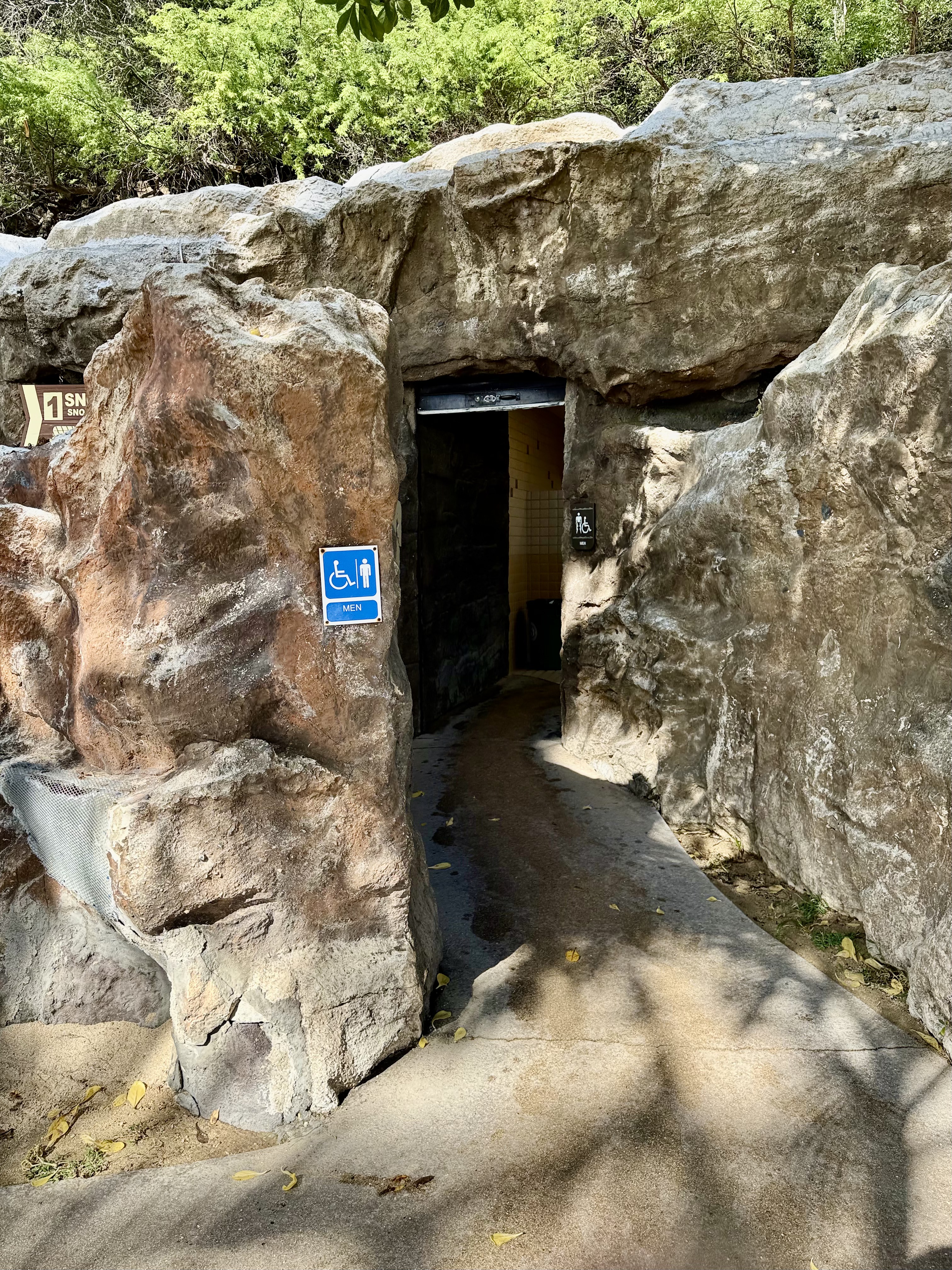
There is a second changing room and restroom behind lifeguard station 3A. You will find a row of shower heads and foot wash behind the building.
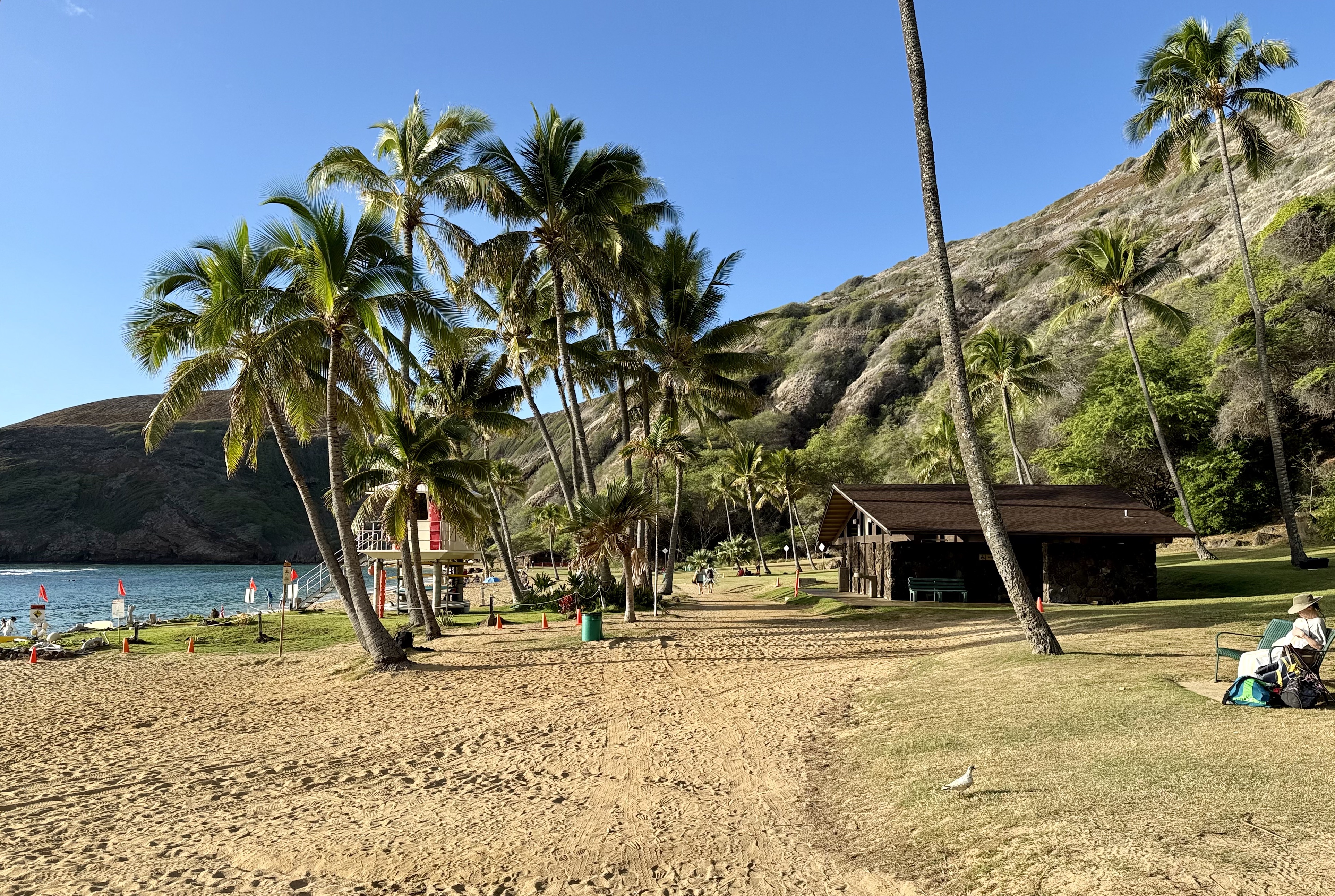
There is actually a third restroom at the far right further down. But that restroom has been temporarily closed off for so long that it may as well be regarded as permanently closed.
Renting beach umbrellas
I maintain that all portable beach umbrellas are inadequate for practical use. They are too small, unwieldy to carry, and hard to stabilize for a full day. You don’t need to bring an umbrella if you will mainly be snorkeling.
Instead, I wore a full-body wetsuit. That was my portable sun protection. It was better than any rash guards, pants and hoods. As a single piece suit, it was easy to put on and remove. I wore a lycra swim jammer under it; the combo worked great.
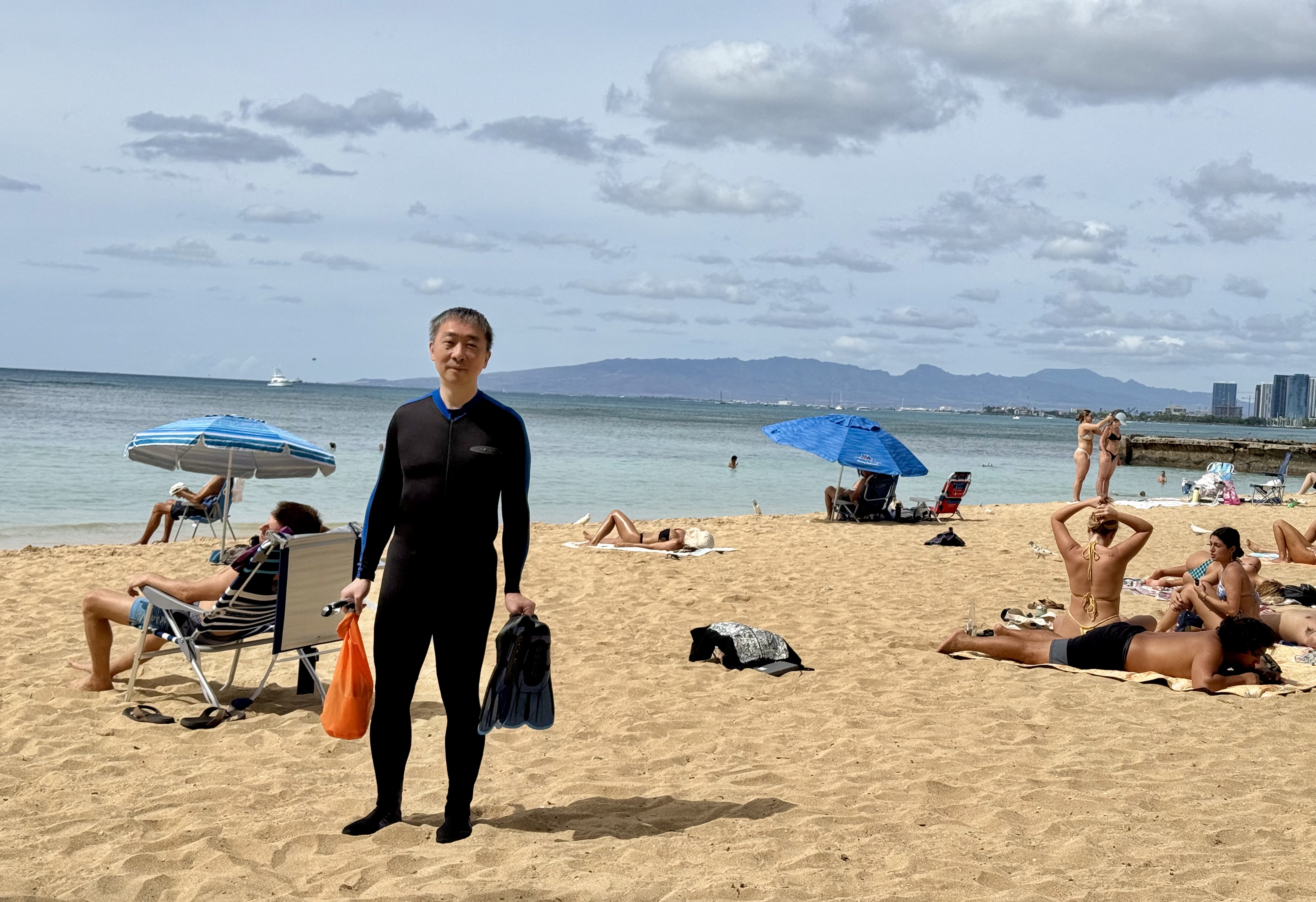
But some folks in your party may simply want to chill on the beach. I recommend that you rent beach umbrellas onsite. You pay at the snorkel rental, and take the receipt to staff stationed further right from the rightmost lifeguard station 3A. You will find them by a row of umbrellas already set-up as seen in the following panorama.
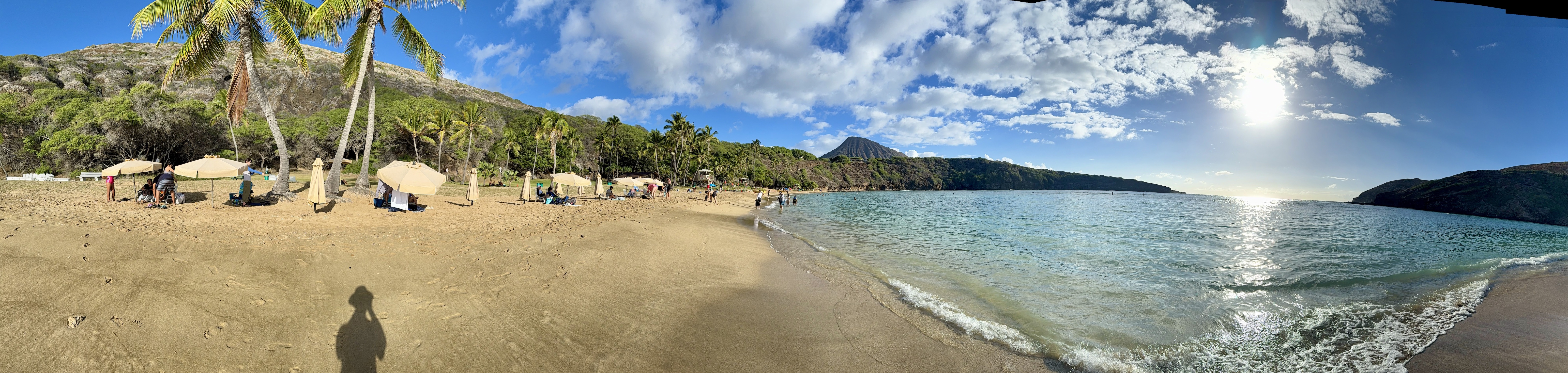
The staff will install a very large umbrella onto a prebuilt platform under sand. The whole setup is sturdy and robust. I think it’s worth the money.
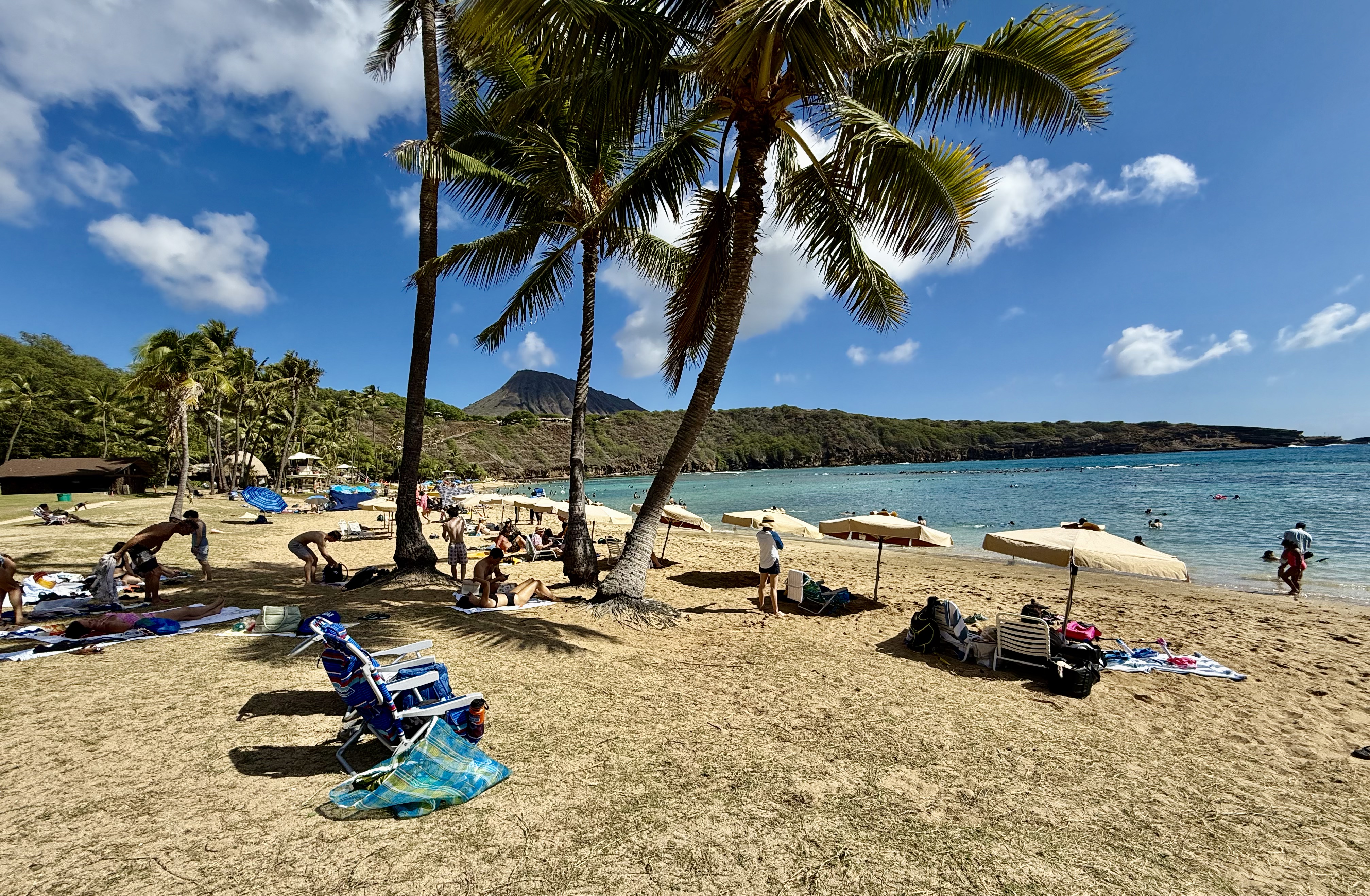
We brought our own lightweight chair, courtesy of our hotel. But you can also rent a chair as part of an umbrella package.
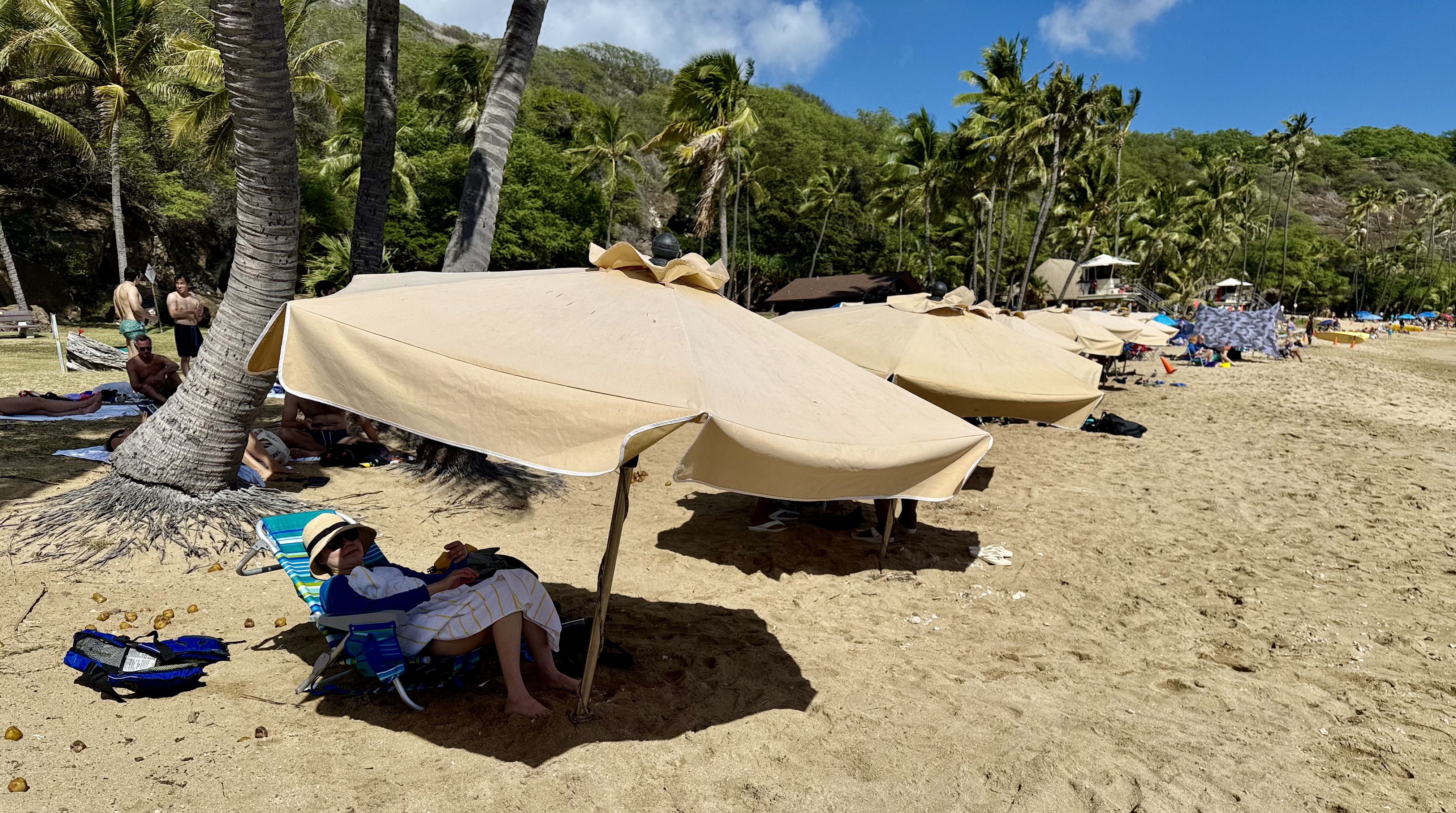
There is only one possible downside to the rental. And that’s the location of these umbrellas. They are planted on the right side of the beach that fewer snorkelers frequent. There is a reason for that. You won’t see many fish close to shore from this point onward toward the right. Most visitors congregate on the left side of the bay where more fish can be seen right next to shore.
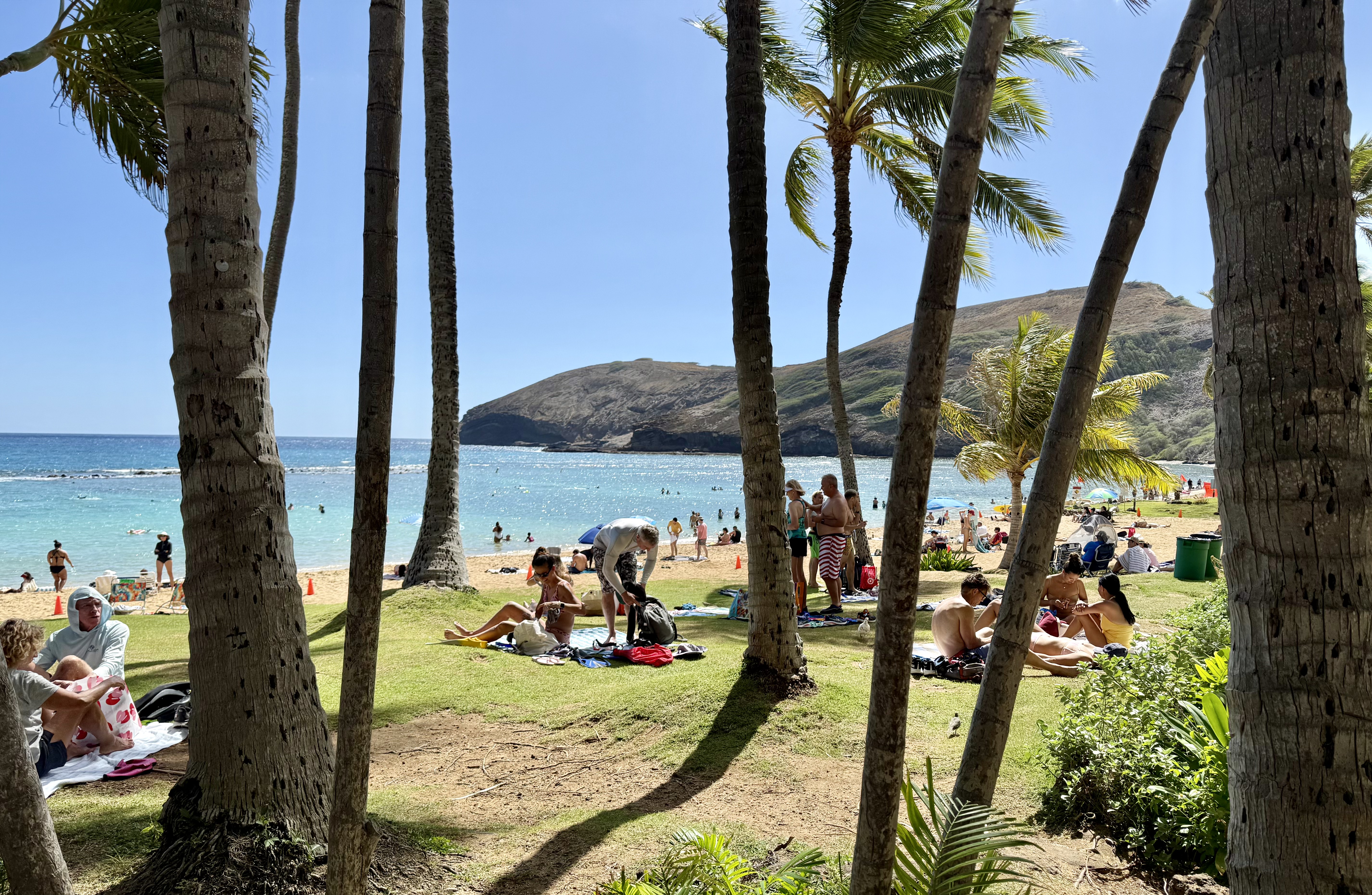
Some people seek shade under palm trees. But their shadows move fast as the sun climbs up the sky; you must keep shifting to catch up with them. The grassy area beside lifeguard station 3C, surrounded by palm trees, is popular with visitors.
Fish you may see at Hanauma Bay
There is an information booth not far from the snorkel gear rental.

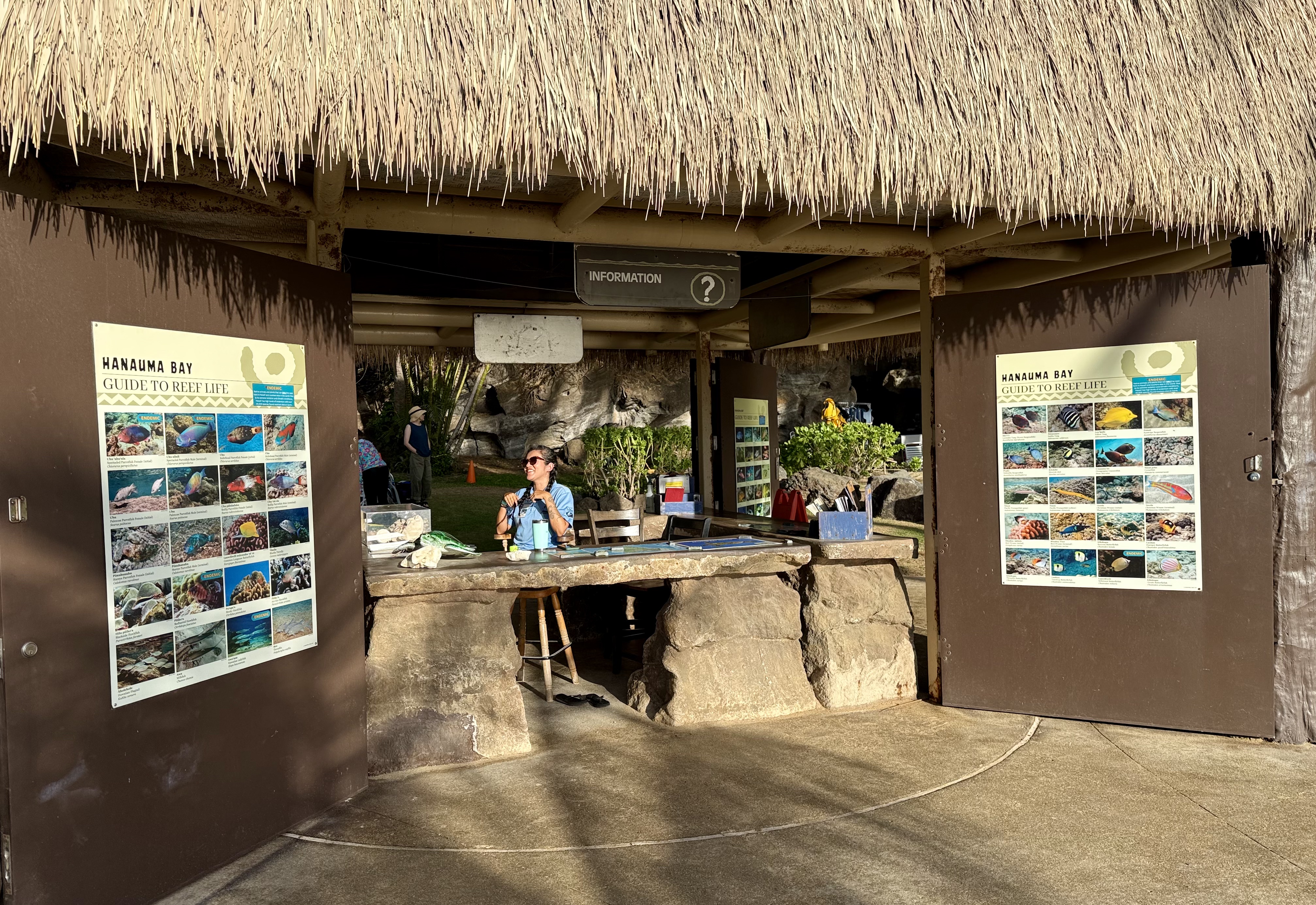
These are animals you may see at the bay. I don’t think you are going to see whales here. I am not so sure about dolphins. But there are definitely green turtles. I think I’ve seen at least 1/5 of listed species in my short trip.
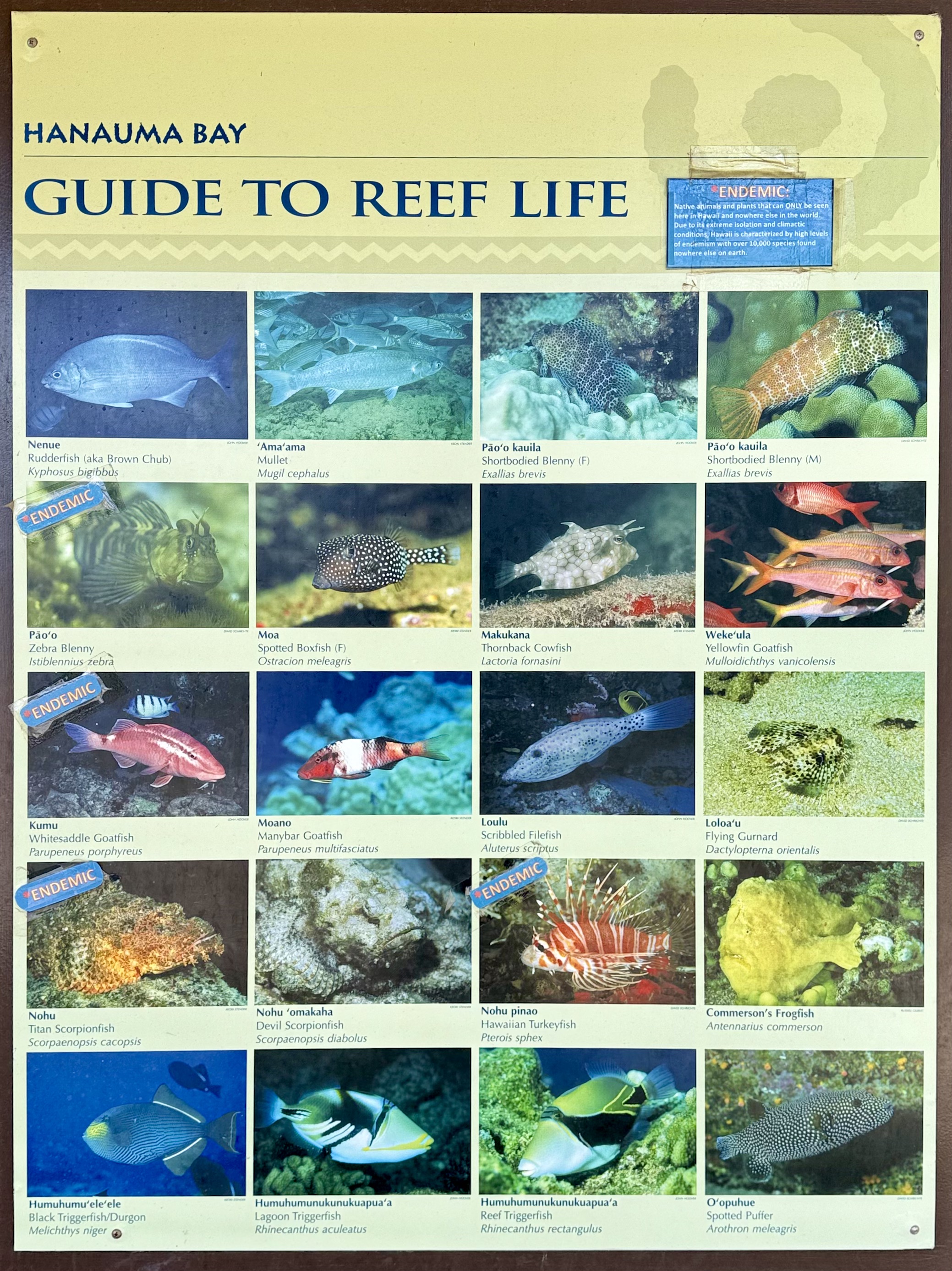
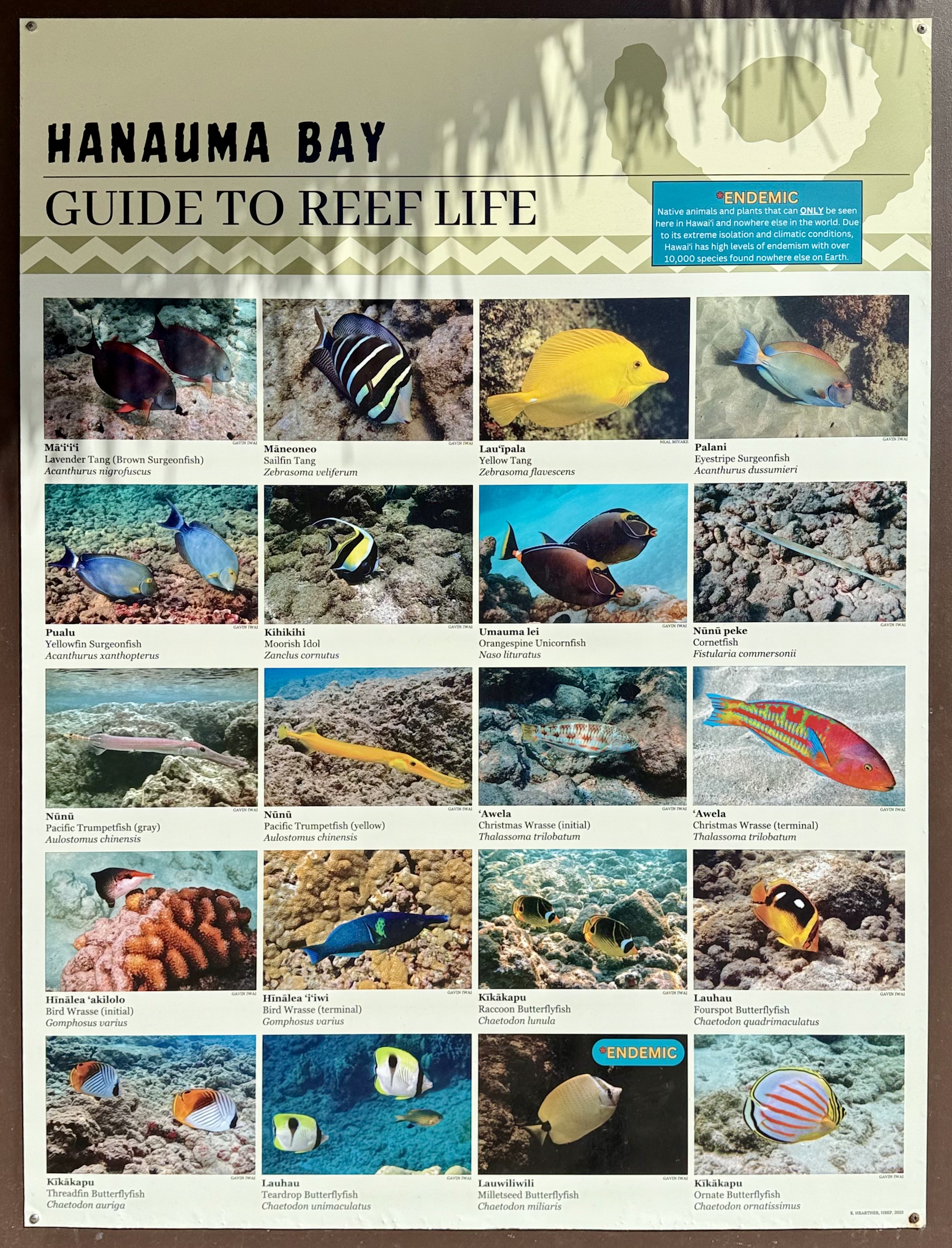
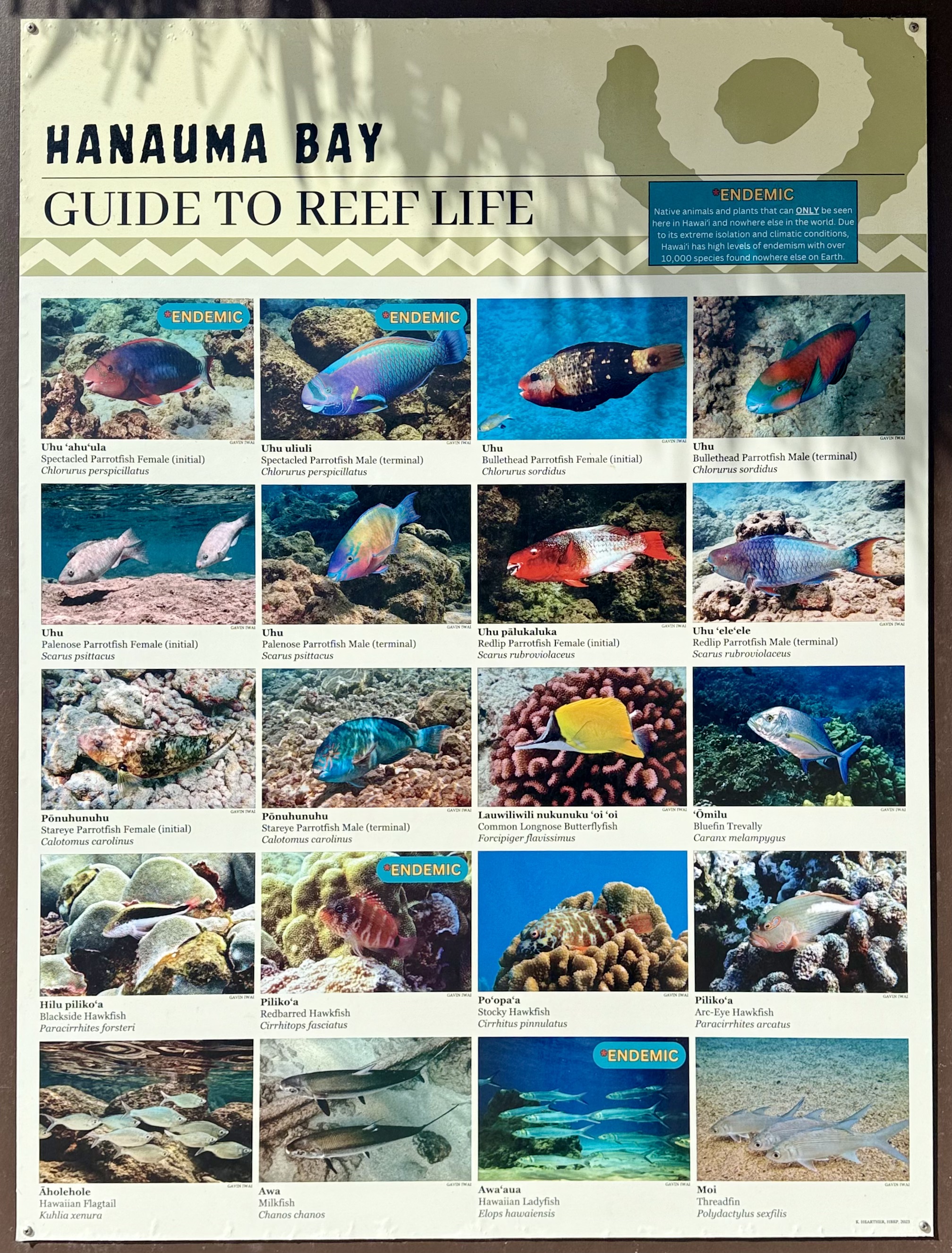

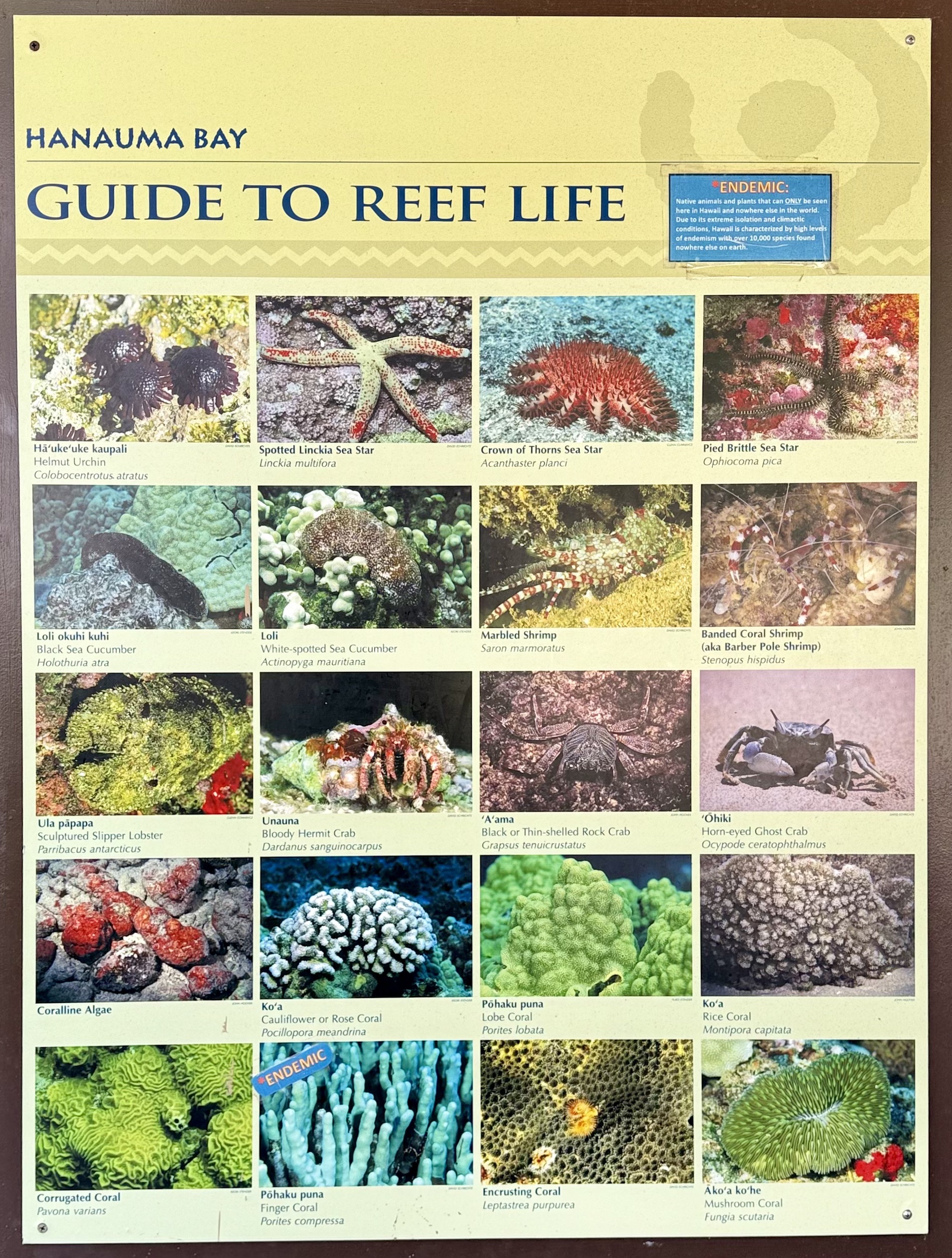
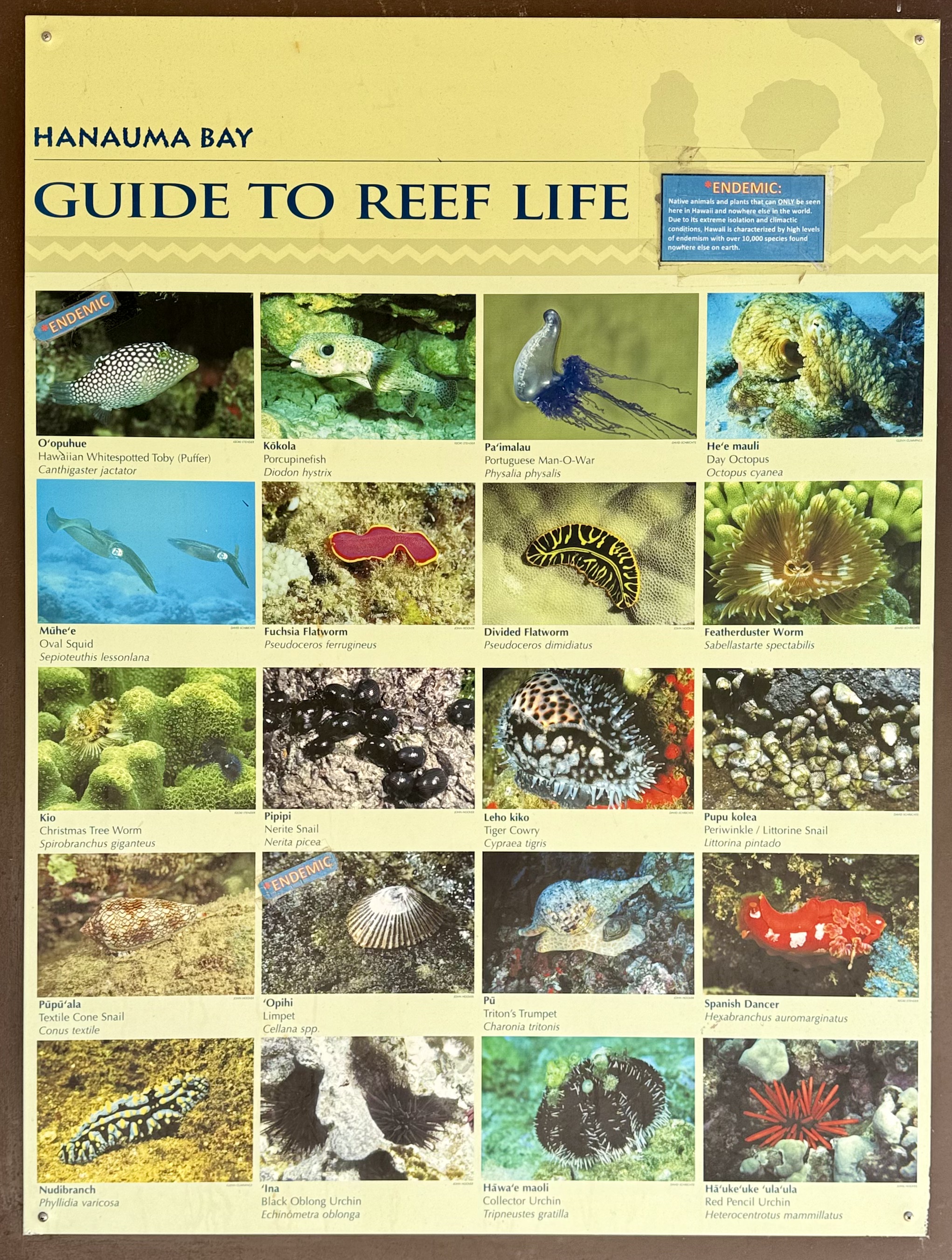
This official site shows pictures of fish and animals taken at the bay. Click on each thumbnail to see full-resolution image and description.
At what time do I show up at the gate
So you show up at 8:20am at the gate, if you managed to secure a reservation for the 8:20am slot, right?
Wrong.
Your ticket says that you must be in line 15 minutes before admission time. That would be 8:05am in this hypothetical case. But you want to take parking into consideration as well. If you arrive early in the day, say 8am, you may have no trouble finding parking. But the parking space is limited, and there is no reservation for parking. If you can’t afford to not get in, consider arriving way ahead of your admission time just for parking.
In addition, the staff may let you in ahead of your scheduled admission time. In our case, they let us in right away when we showed up at 7:30am, despite the scheduled admission time being 8:20am. Some people on Reddit reported being let in 2 hours ahead of time. But your mileage may vary. Perhaps they let us in early because actual attendance on that Friday in a shoulder season was low enough.
Note that showing up before 6:45am is a futile exercise. The gate by the highway isn’t open until 6:45am. You will have to continue driving past the gate, and then circle back again later, if you show up before the gate opens.
Consult official rules and processes.
Daily attendance at Hanauma Bay
You may read differing accounts of daily visitor numbers at Hanauma Bay, ranging from some 700 to 3,000, or even 4,000. This is because they are quoting different types of visitor numbers. They may be using data from different years, or possibly even decades.
Before today’s reservation system was put in place, the bay saw a peak annual attendance of 3 million visitors in 1988. Assuming that the park was open 365 days then, that was an average of 8,200 visitors a day. See park history.
Since then stricter reservation system and maintenance closure have been gradually adopted. As of the time of this writing in December 2025, the park is open only 5 days a week. According to actual recorded attendance data, the bay received 400,776 visitors in 2024, which meant an average of 1,541 daily visitors, assuming the bay closed on Mondays and Tuesdays.
But the 1,541 daily attendance includes two types of tickets. On average, 884 people actually showed up daily, after making an online reservation two days before. And 657 people walked in.
This stat surprised me.
The park lets more people walk in than most realize. I am aware that a non-trivial fraction of walk-ins were residents who don’t need to make reservations. But data showed that on average, 413 non-resident adults simply walked in every day.
Also, more than 10% of people don’t actually show up, after booking and paying for a reservation online. We thank them for supporting the conservation effort.
You’ll find an attendance log for each of the last few years on the official conservation page. Note that the 2025 log shows unusually-low attendance for September. That was because the bay was closed for repaving for a good part of that month.
Book reservation 2 months before your trip
Yes. You can actually book your visit to Hanauma Bay up to two months before the admission date. I wish I knew this before my trip. I only found out when writing this long essay.
All official and semi-official websites prominently display buttons for you to book “Hanauma Bay Transportation”. But I never looked at them, because I was going to drive to the bay myself. These links should have instead been labeled “Book combo package TWO MONTHS in advance”. That would have caught my attention.
In fact, I thought the semi-official page was showing ads to take advantages of ill-informed tourists. See for yourself.

As it turned out, this is a legit combo package that bundles transportation ($40) and entry fee ($25). And it is run by a local business certified by the government. But unfortunately I didn’t spot that phrase “a month in advance” on this official page, and thus never clicked on “Book Now” to find out.
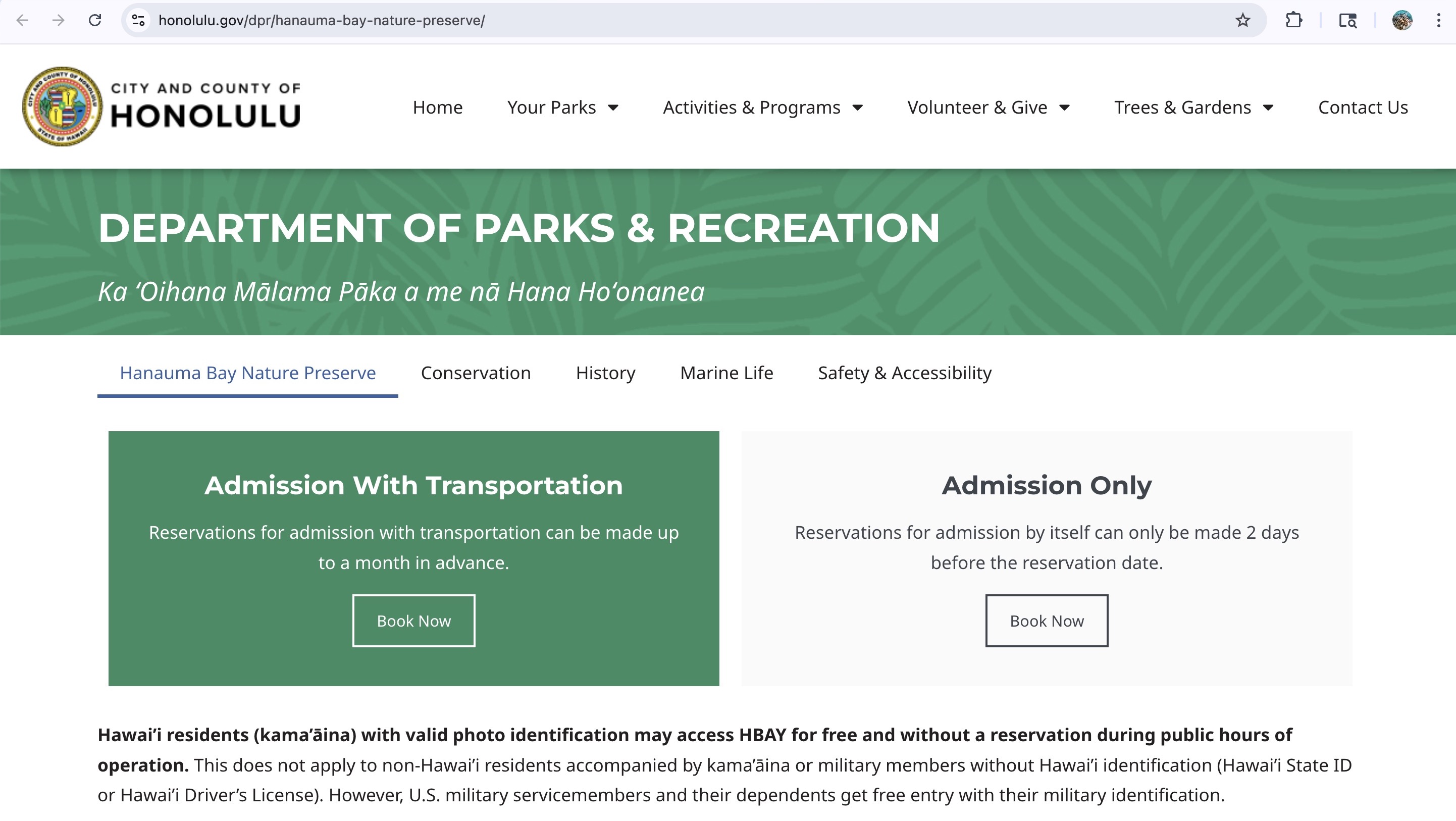
I played around with the transportation booking page, just now. It shows a calendar for you to pick a date. You can select a date from the current month as well as from the next month. That’s why this Roberts Hawaii page says “30-60 days advance Bay ticket purchase”.
Now you have three options for getting into the bay: 1) transportation combo booked up to 2 months in advance, 2) online reservation exactly 2 days before, and 3) walk in.
I do not know how such combo visits are recorded in the attendance log. Are these classified as residents or non-residents (aka tourists)? Are these perhaps classified as walk-ins?
Alternative snorkeling venues
If you can’t secure reservations to Hanauma given your schedule, you still have alternatives. It is true that water here is in general the calmest and most clear on this island. But you can find the same fish and probably more elsewhere.
If you stay around Waikiki, like most visitors do, then you just need to walk to the nearest beach in the Waikiki series of beaches. If you are a good swimmer, almost all beaches lead out to reef where you will find fish, and more importantly, green turtles. You will have to contend with mild waves. Some reef are in the path of surfers, such as the reef outside the north Kuhio Pond. Countless surfers paddle out to surf past this reef towards Kuhio Beach. So watch out for surfers and don’t get too close to their path.
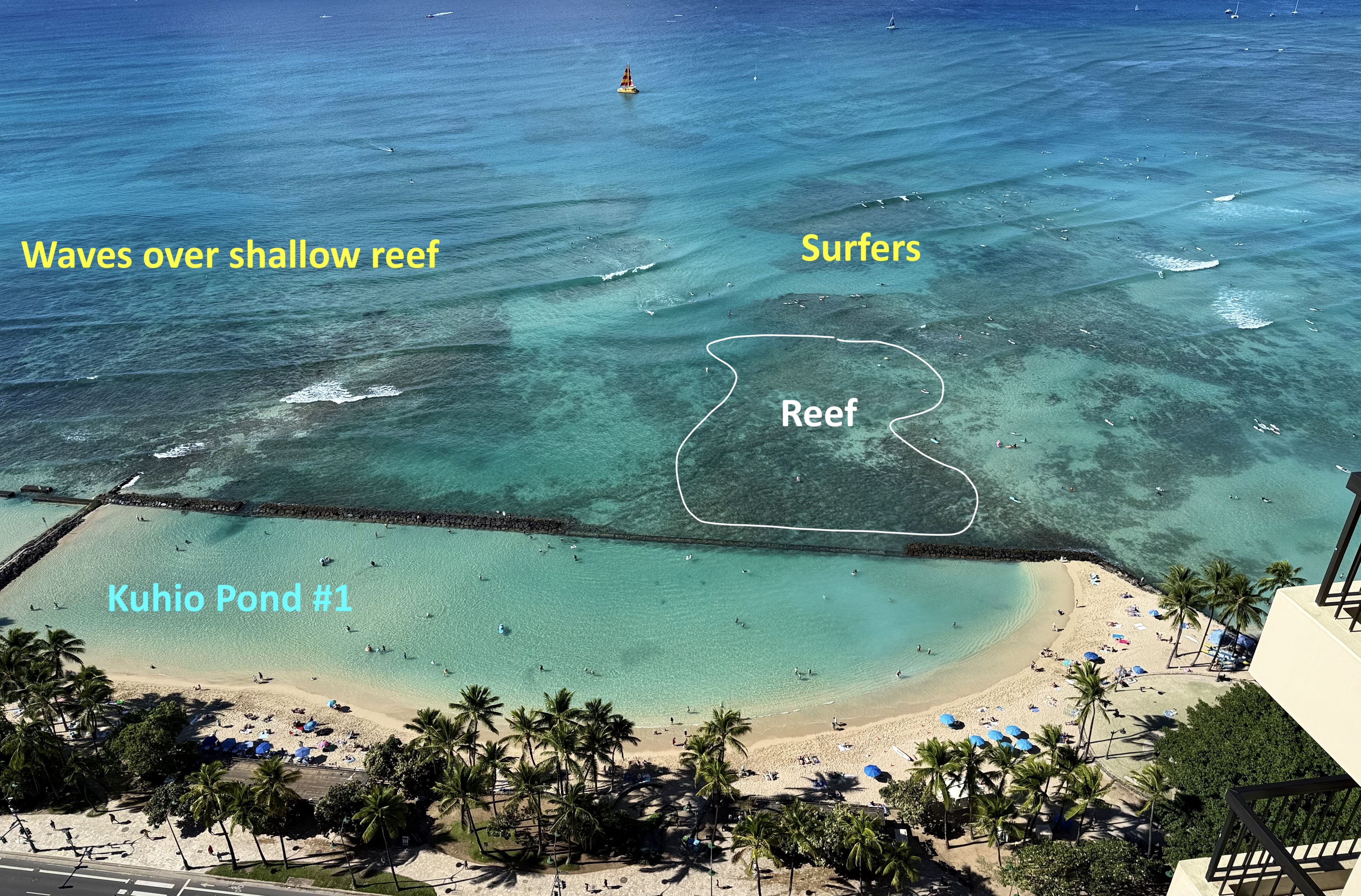
For a beginner snorkeling experience, start within the rock walls at the first of the two Kuhio Ponds. The entire wall marked “A” is filled with fish of the same type you may find at Hanauma Bay. They are smaller though – they swim in and out of gaps between rocks at the wall. For the entire “A” stretch, you can simply stand on sand and stick your head into water to look at them. I am surprised that most visitors to the pond are unaware of these fish. Those in the know swim up and down the wall to look at them.
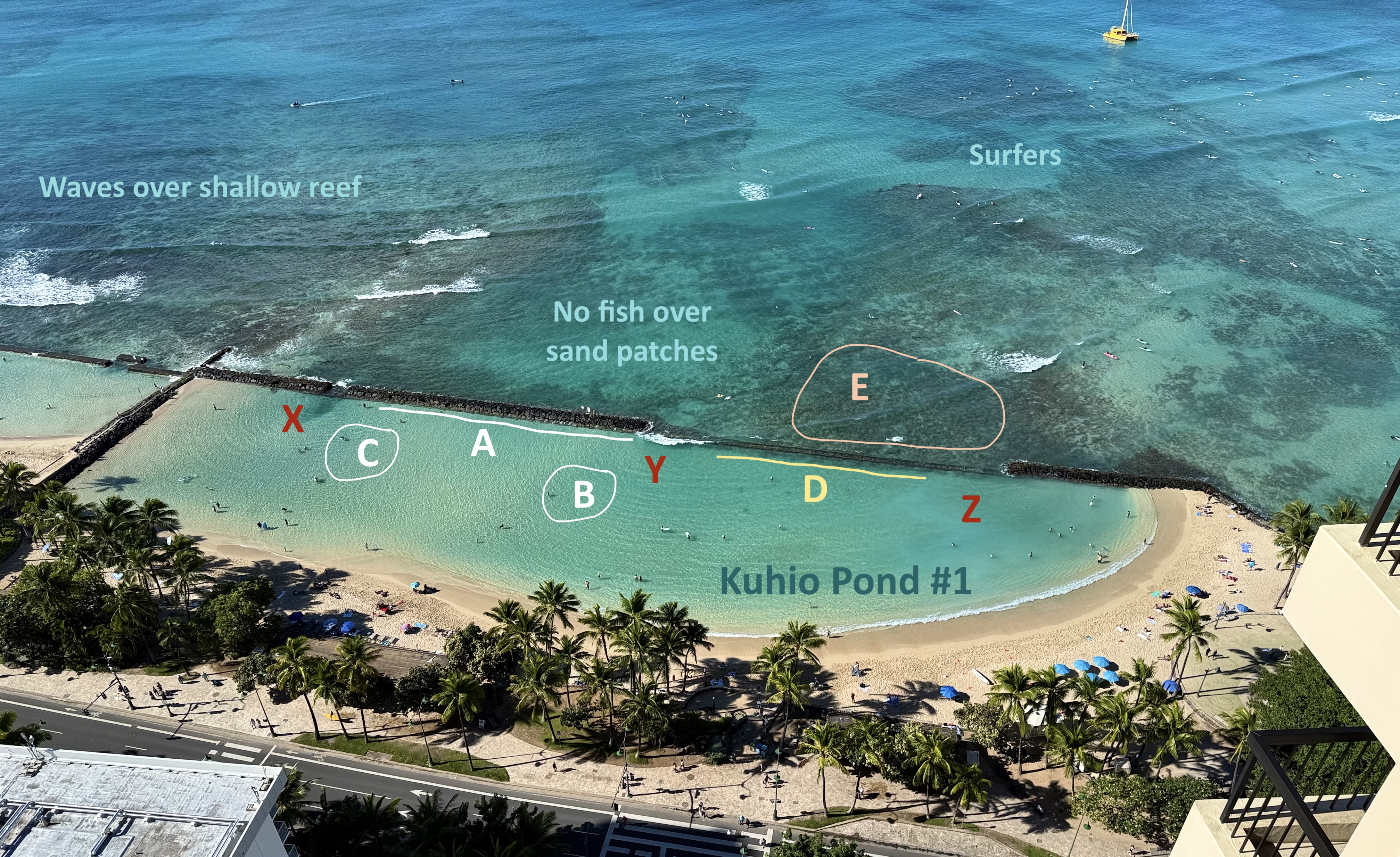
I always found schools of juvenile yellowstripe goatfish within the pond, over a week of my November stay. They are called ‘oama if under 7 inches in length, and they look quite different from their adult versions. I found them congregating by areas “B” and “C”. They were there every day. I also found them at Kaimana and Kahala. They seemed to be everywhere in November. Where you find ‘oama schooling, you will usually see a few juvenile trumpetfish as well. I don’t know why that was the case.
I found an assortment of fish by the rock wall stretch “D” as well, just like stretch “A”. But this whole stretch is a water inlet, and mild waves wash into the pond through this inlet. The water is slightly murkier. Venture into this stretch if you feel comfortable with its deeper floor.
I grew more confident after a while, after watching the height of waves from inside the pond. I practiced breathing through mild waves that washed in. And eventually I swam out of the pond through the inlet into area “E”. I found larger versions of same fish, including all sorts of tang, triggerfish, butterflyfish, parrotfish, wrasse, and bluefin trevally. I saw a huge moray eel out there. And two green turtles came into my view within a span of 20 minutes. I stopped swimming, and simply hang in the water watching these graceful creatures munch on the reef.
There is no fish to see within clear sand patches. Avoid path of surfers as mentioned earlier. And I found the reef outside of the southern Kuhio Pond to be too shallow, and wave action too strong to be enjoyable. Perhaps it’s different on a different day at a different tide.
Stay away from the inlet marked “X”. Waves rush into the pond through this small inlet, carving out a deeper floor. But I think that’s why ‘oama schooled near this inlet. Similar, “Y” is where waves create a slightly deeper floor on the other side, and why there was also a large school of ‘oama there. The whole area marked “Z” is murky; avoid this area.
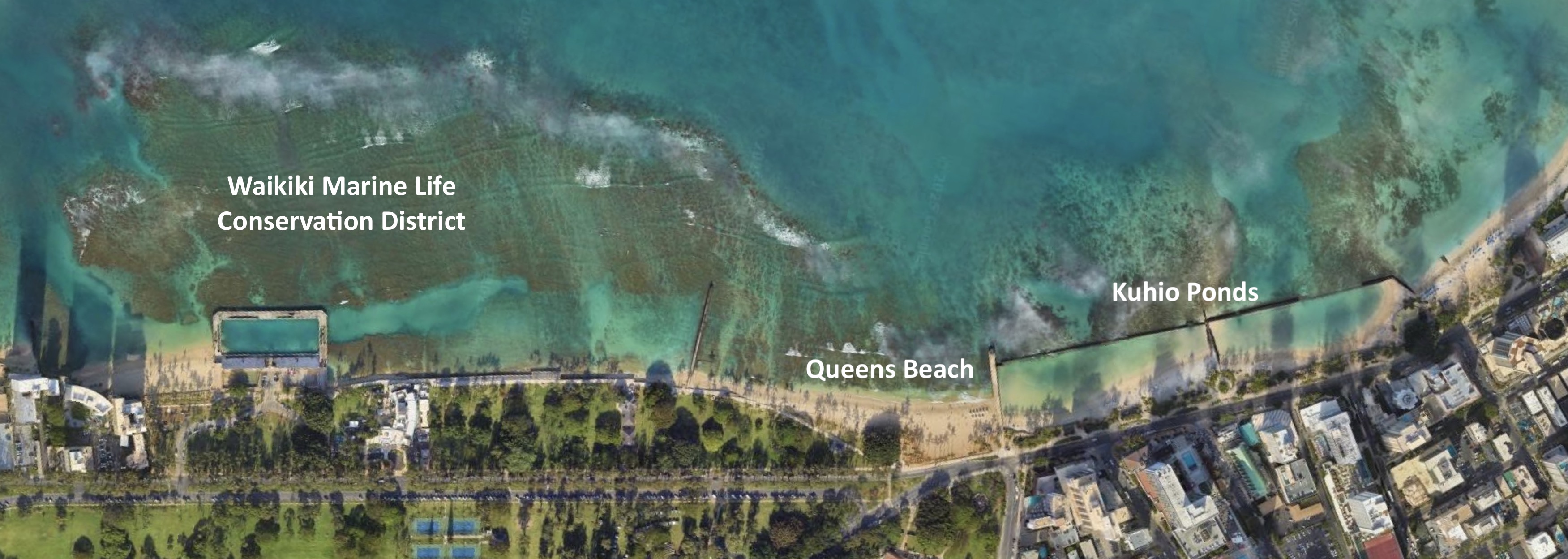
You will also find reef further away from Waikiki center. The entire stretch of Waikiki Marine Life Conservation District is off limits for fishing. You can launch into this reef from Queens Beach. See Jordan’s film.
You may also consider other activities. Why not take a kayak trip to the sunken Kaneohe Sandbar?


 Xinhai Dude